
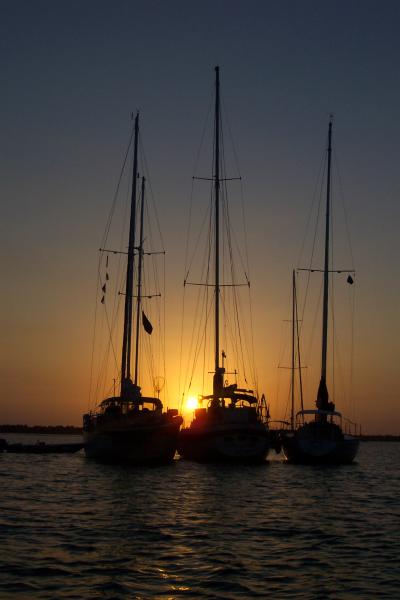
There are multiple sub cultures, just like on land you can have mountain men, and hermits, spanning to high rise condos and mansions. This is the narrower band of culture that I was more deeply immersed in, with homeschooling and family life, and the broader scope of general boating social dynamics.
Sitting at anchor, using the sailing dinghy to get to and from shore, fishing for your dinner and burning candles for light.
Tied to the dock, with the utilities to provide modern comforts, and the car parked in the lot to go down to the shop for fresh veggies for dinner.
Transportation
One of the first questions I get about living on a boat is “How did you get around without a car?” When living in a marine orientated city, there are many shops and conveyances very close to the water. In this sense the family car is the dinghy.
Shuttling to shore, and walking to your destination, provide an active and healthy lifestyle in addition to saving on petrol costs. You are also more likely to buy things you need, and cut out junk food and inconsequential items that are not ‘worth’ the effort of hauling back to the boat. Quite frequently, people will have a bike, or small moped, that can be shuttled to shore in the dinghy to use. In some instances, live-aboards who maintain port at a dock will choose to maintain the comfort of a vehicle for longer trips, and the boat being at dock is for longer term living.
Food and Diet
When living in the middle of the ocean your main sources of food would probably what fish you caught, and the edible seaweeds that you could harvest. This style of living for long derations, and especially not planned, is rare. The common approach to long term voyages includes detailed planning of routes, studying weather patterns, and stocking up on rations before leaving port.
Before leaving for the Bahamas for 6months, I remember going to the store with my family. We had sat down and planned out what we would need to make each meal, then multiplied it by how many days we would eat that meal and multiplied that to how many meals we would need to ration the whole journey. Leaving out produce and other perishable items that we would buy in the islands, we still had 5 full carts of food to prepare for the journey. We had such a large number of items, they could not be rung up in the same transaction at the register.
Community Structure
The sailing community has three main niches; Marina, the hard (boatyard), and anchor/moored.
The Marina is considered the most social of the three niches. Here the equivalent of a neighborhood is slips along the pier. There is the ‘neighbor dynamic’; The neighbor that offers to help with some maintenance, ‘neighborhood watch’ becomes ‘marina watch’, and there are the conflict neighbors ( e.g. leaving lights on, music too loud, ext.). Marina offices usually provide a central hub to the social dynamic. If the office facilities are highly restricted and hard to access, there will be less interaction in these areas, where as a marina that provides larger free space to its guests will draw more people into the social setting. This would be the equivalent of the “city” of the boater world.
While on the hard, boaters are usually working on their boat, whether its basic maintenance or extreme repairs/renovations. The people that are in this working environment tend to have more of a ‘business’ scene, trying to get the job on their boat done. The social dynamic of strangers in this environment is more of a friendly passing in the work place. Here it is assumed that people at the yard are doing some form of maintenance, or preparing for storm seasons. The work yard would be most closely related to the suburb; people going about their business with some interaction, though there is ‘personal space’ associated with the area around the boat in addition to the boat itself. (Leaving a drill under your boat could be seen as the equivalent of leaving your lawn mower on your front lawn, it is assumed that the lawn mower, or in this case, drill, is associated with the property that it shares a space with.)
The ‘rural’ form of living would be at anchor or at mooring. When living with such large amounts of space between boats, interaction is limited. The most common forms of social interaction are particular social events (e.g. dock party on shore, meeting at a boat for cocktails), or spontaneous interactions (e.g. meeting at the dinghy dock en-route to the store).
Education
Families living on boats are often home schooled, allowing for mobility and convenience. With the diverse offering of education programs, there are self guided work books, satellite ‘Skype-in’ class sessions, and other correspondence curriculum establish that can provide your standard education requirements. However, when living on a boat, there are the opportunities to study biology by dissecting a fish and taking the time to learn the organs, maritime history is common around coastal regions, and (with homeschooling in general) individual interests can be developed by incorporating them with school work. (Like astronomy? write a paper on how Columbus used stars to navigate. Like electronics and chemistry? Perform an experiment about the conductive properties of salt water.)
The other education alternative presented was enrollment during the school year, leaving summers and holidays to travel. Restricting time allowances for travel usually is associated with leaving the boat at dock for longer periods of time and in many cases results in the family moving back onto land before much traveling takes place.
Waste/toilet
As you can imagine, I’m hitting all of what I think are the no-brainer parts of living on a boat, when a girl I’m talking to asks “this may be gross, but what did you do about going to the bathroom?” I had forgotten all about that naturally human action that is dealt with differently in this living environment.
On a boat the bathrooms are small, usually just large enough to accommodate a small shower and the head (toilet). The toilets are small, and manually flushed by a pump. Once ‘flushed’, the waste goes to a “holding tank” which is emptied by a pump at the dock. The other method of flushing is an Electisan which works like a septic tank, treating the waste for deposit into the ocean. Sink and shower drains have through halls into the water, or into the bildge (the open area under the floor of the boat which usually has a small amount of water) and is pumped out into the ocean.
Other trash should be stored for disposal on land, and organic matter can be disbursed out in the ocean to decompose.
 TravelGypsea