Tag Archives: gadventures

Hakuna Matata: Zanzibar

An early morning shuttle took us to the Airport where we hopped onto a larger prop plane, headed to Zanzibar. The seatback magazine recipe for a shrimp dish kept me entertained while my seat mate took photos from their window seat.

I had packed my camera and lenses in my day pack, nestled at my feet and was able to get a couple photos with the help of my seat mate, and looked out over mainland Africa one last time before the attendant gave me my mango juice and cashews. (Definitely felt like a step up from tomato juice and peanuts.)

Our arrival into Stonetown, my group descended the staircase and crossed the tarmac into the terminal. My bag came off the carousel when rounding the conveyor corner, landing with a loud THUD. I counted my lucky stars that I transfer my lenses to my small pack for flights.

Outside the airport we joined up with another GAdventures group that had just finished climbing Kilimanjaro, and bypassed the safari segment that the crew who continued with me had done. Our trip had departed a few good people, and gained a few more. By the end of the trip I counted up that I had made 20 new acquaintances from 7 countries, and from the US from 4 other states. Talking with my guides, they both said that one of the reasons they love their jobs is the very different people they get to meet from all over, and getting to show people their little corner of the world.

Our next guide for this portion of the trip, Kombi, loaded us up into a bus and headed into the city to our first nights accomodation: The Spice Palace. To get to our hotel, the bus cannot make it down any streets in the main city. The narrow streets being from long before car transportation was a consideration in building plans. We loaded all of our bags onto a wooden cart, making a towering mound of all the luggage. A smaller older gentleman who approached and loaded it began to pull it down the alleys. We follow, stopping at the stairs at the front of our hotel, each of us claiming our bag and beginning the check in process.

After dropping bags in our rooms, there our group gathered and made our way to lunch at a nice little place near the beach, The Silk Route. The first thing we noticed was how friendly the stray cats were to tourists. No doubt having their share of seafood from the tourists who take pity on the creatures. To that end, Its safe to say that Zanzibar probably doesn’t have a rodent problem.

After lunch we went to the historic slave market museum. Stonetown had been the major slave trade port for Arab controlled East Africa. on the historic grounds they had the ‘whipping tree’ which had been cut down, and over its place a church was built, a circle on the floor where the tree used to stand. The displays in the museum showing the evolution of the slave market, and the original holding cells for the slaves before they were loaded onto ships. It was a somber experience, but one I am glad gets visited and people learn this history.

Sample of one of the displays

We took a walking tour of the town after, learning about the ties of stone town to Queens’ Freddie Mercury, the town even hosting the Freddie Mercury Museum. A group of kids down at the sea wall were filming jumping into the bay with poster boards reading ” Welcome to Zanzibar!”, shouting ‘HAKUNA MATATA!’ and ‘WAKANDA FOREVER!’ We continued down the narrow ally ways, where doors are adorned with large spikes. The reason? People who moved into these areas were from India and would have spikes on the door to keep elephants from barging in. When they moved to this city, with streets far too narrow for elephants to ever pose a risk, the style of door came along anyway.

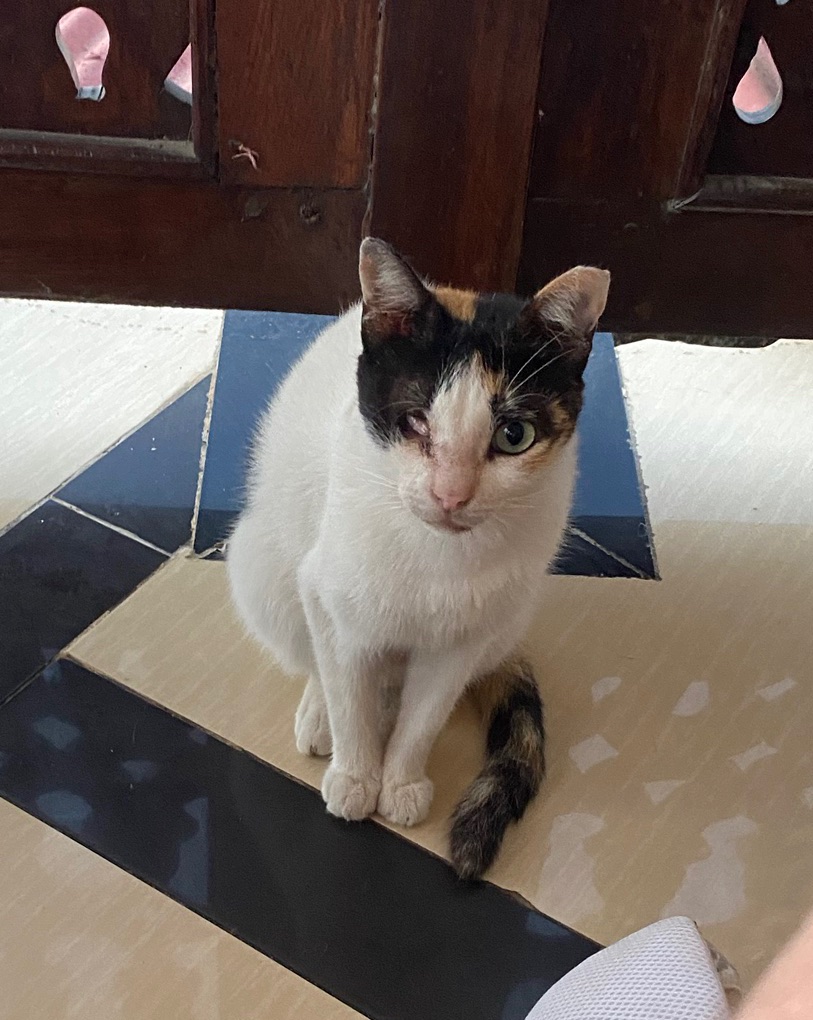
Back at the hotel, I joined the Canadians and the Aussies for a drink at the rooftop bar. The resident stray coming up when I notice he was underdeveloped and was missing an eye. My own cat at home being massive and named Sully after the Monsters Inc character, I felt it was only fitting to nickname this little guy Mike Wazowski.

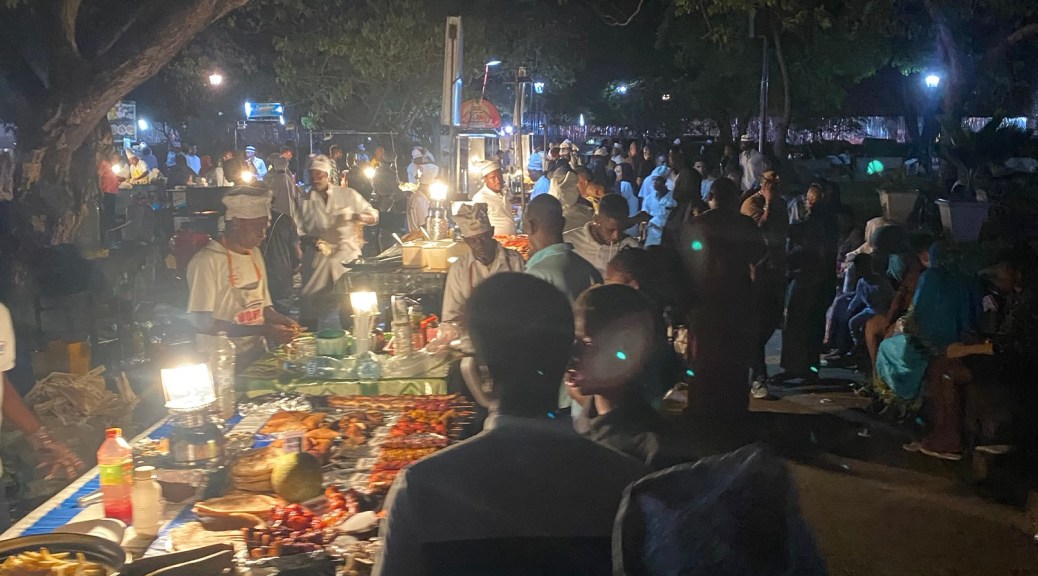
That night we all ventured off for the night markets, which was a bustling scene of food vendors and people. Our guide recommended certain foods we could try if we were feeling adventurous, but warned against others as it’s ‘laid out’ a few westerners.

Finishing up at the Freddie Mercury Bar, we dined and drank and listened to some wonderful local live music before making our way back to our hotel.

Next Time: Visiting a Spice Plantation, given the royal treatment, and get to visit my first resort.

A birds eye view of the Serengeti: Hot air balloon rides and reflective eyes after dark.

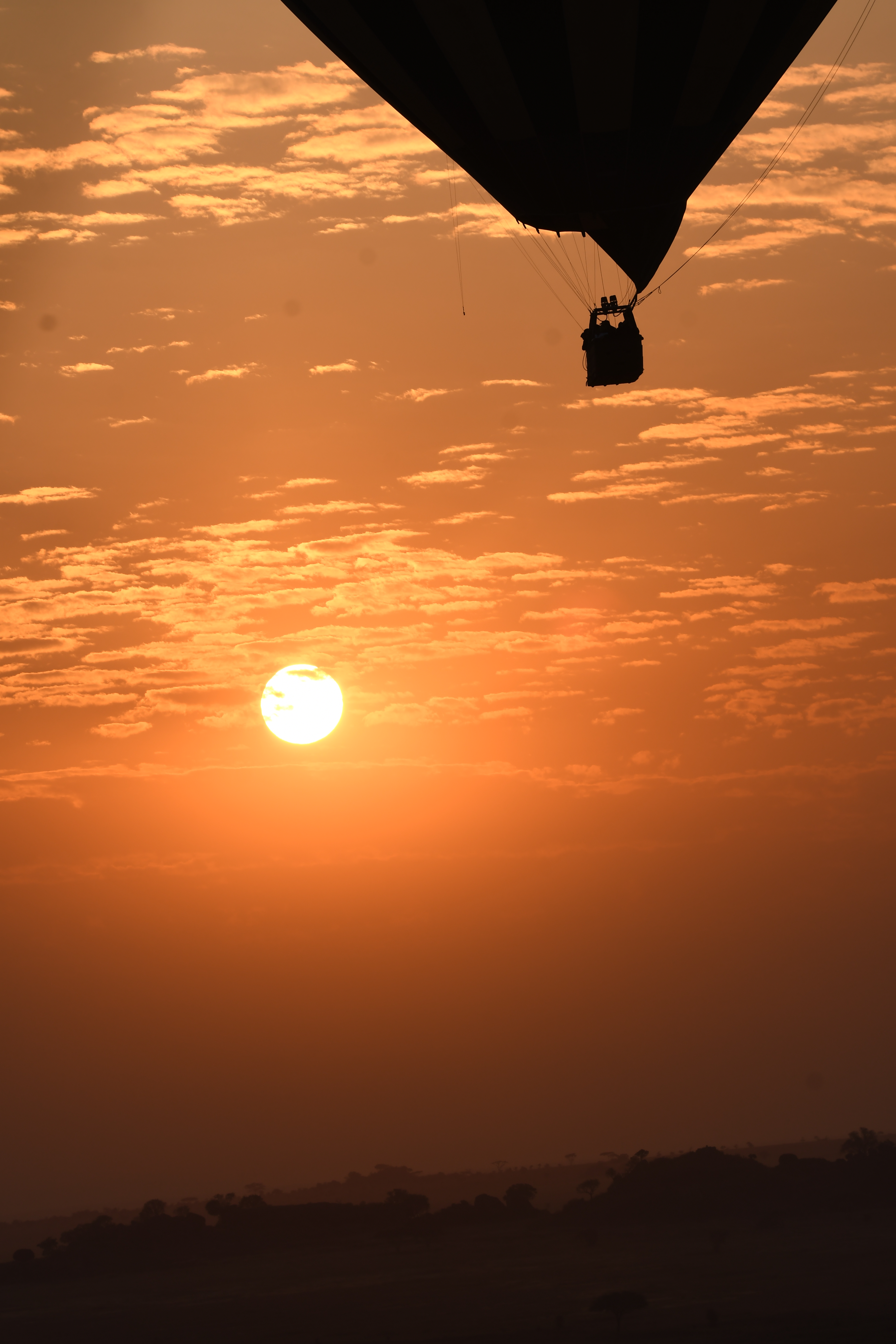
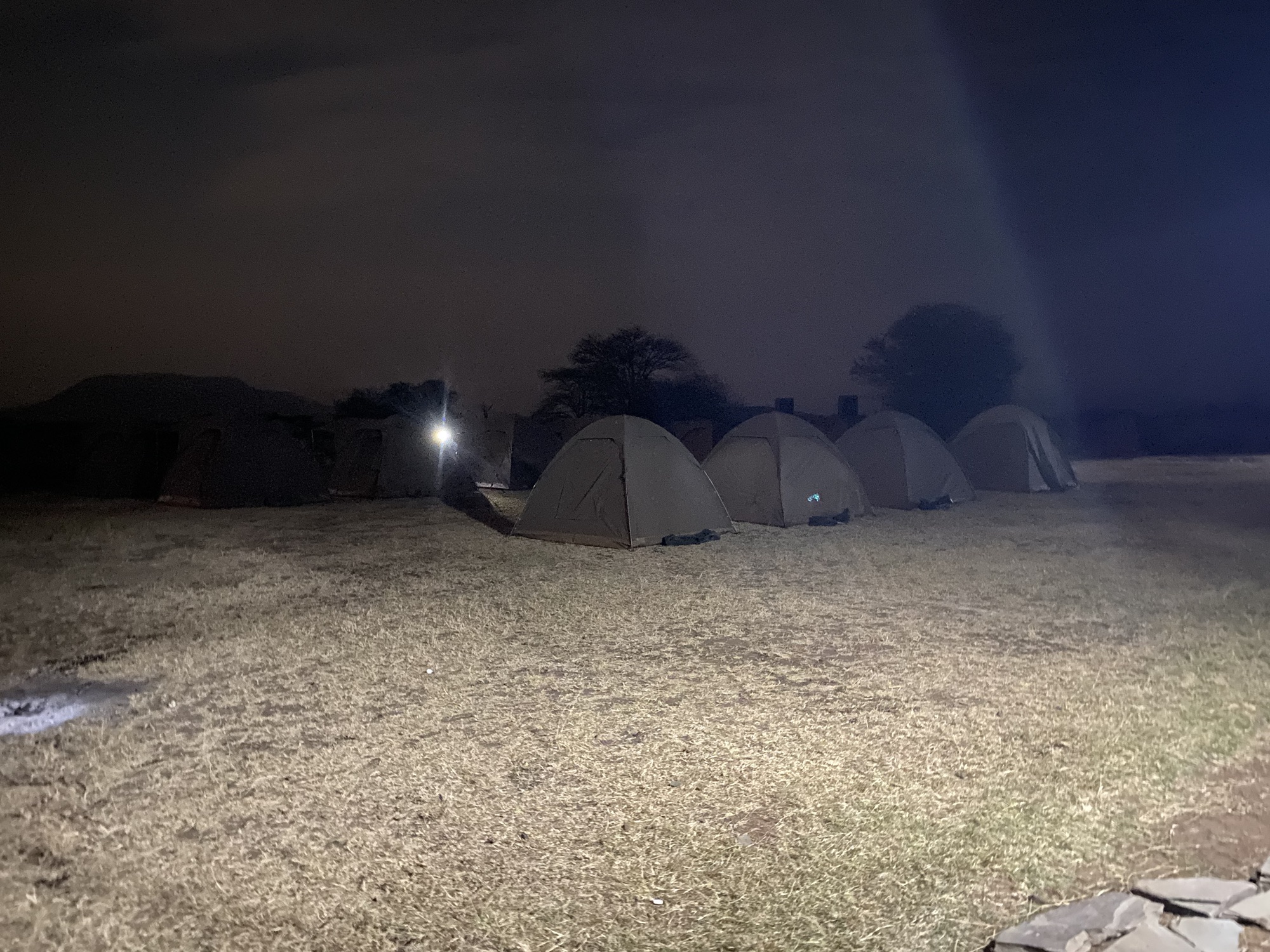
The excitement of the hot air balloon ride with Serengeti Balloon Safaris had me wide awake about 2 hours before my alarm was set to go off. 3:30 am I am laying in my sleeping bag, listening to the stillness of the Serengeti at night. The quiet broken by the occasional heyena call on the other side of the camp facilities from our tents.

Once I start to hear the rustle of my tent mate leaving the tent to get herself ready for the day and had a moment of panic when I realize she left the tent before turning on her light to clear the area. As someone who lives in the wilderness of North America with bears, mountain lion, and wolves, a good rule of thumb is to check BEFORE getting out of the tent. Thankfully she made it to the toilettes in one piece.

Deciding that I should get going too, I got ready for the day, gathered my photography gear, and went to the mess-hut for some pre-breakfast snacks and some coffee. I was just finishing my coffee when our ride to the hot air balloon showed up. The 6 of our party that were going all loaded into the pop-top and off we ventured.

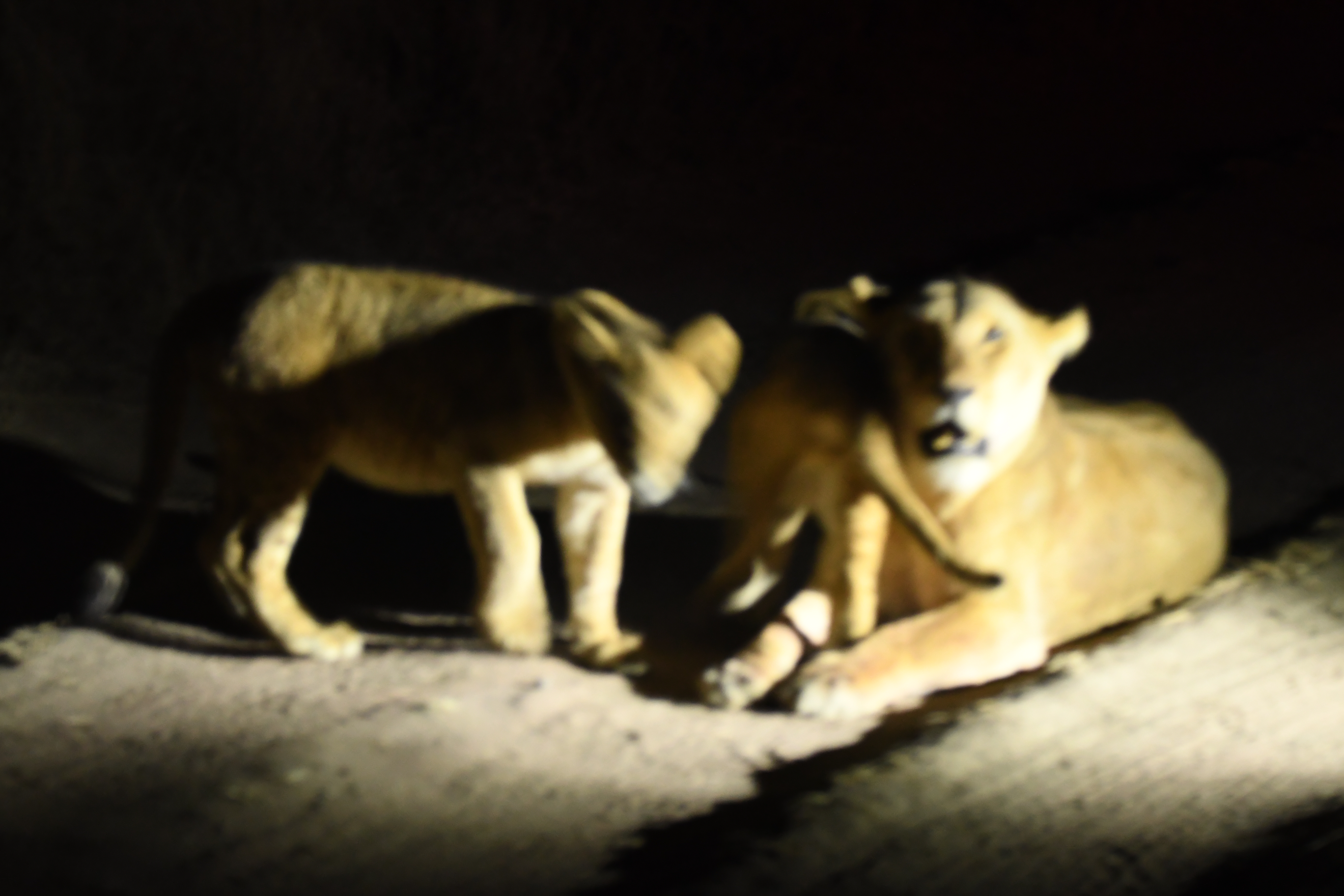
We came across a Serengeti Traffic Jam, 3 mother lionesses and 9 cubs all in the middle of the dirt road path to the launch site of the balloons. It was near enough a new moon that in the pitch black it was hard to get decent photos with my large lens, but the moment was magical. The cubs playing and jumping on each other and their mothers. After a while of watching we continued on by driving around the adorable fuzzy roadblocks.

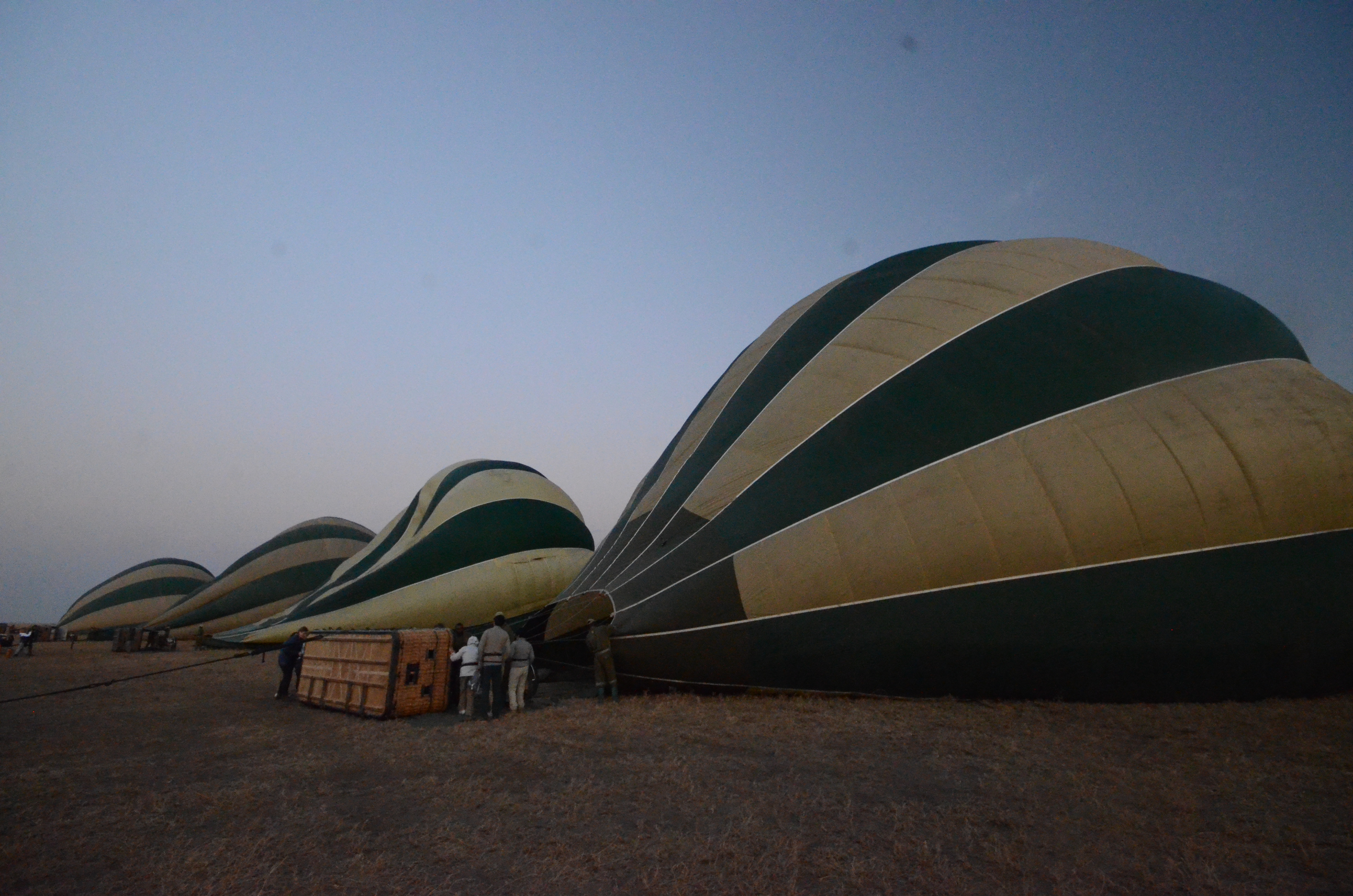
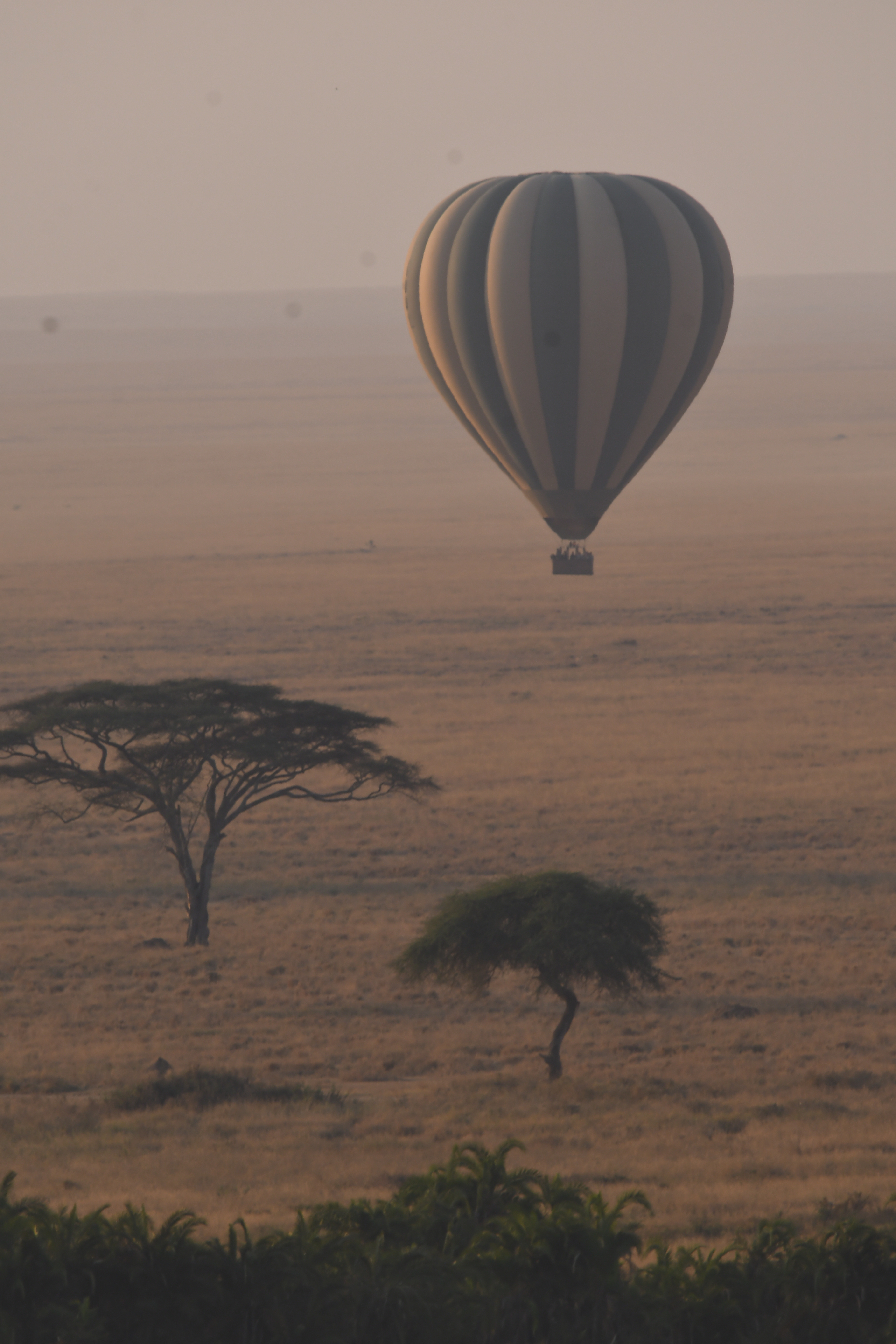
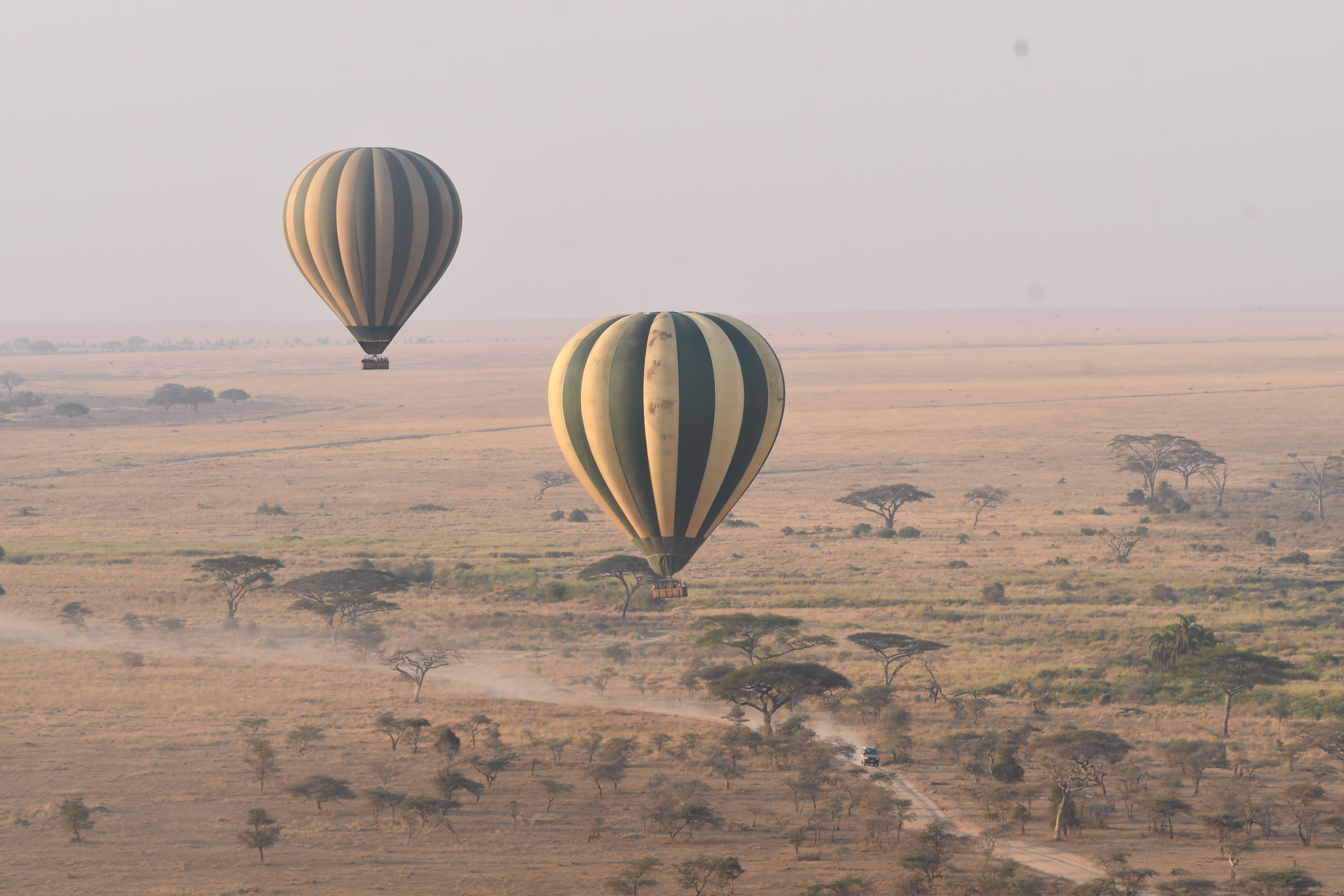
Down the road about 15 minutes we came upon the hot air balloon launch point. The green and tan stripped balloons on their side, being inflated by their pilots and attendants. We were treated with some ginger coffee and balloon shaped shortbread biscuits while we waited, appreciating the oncoming sunrise.

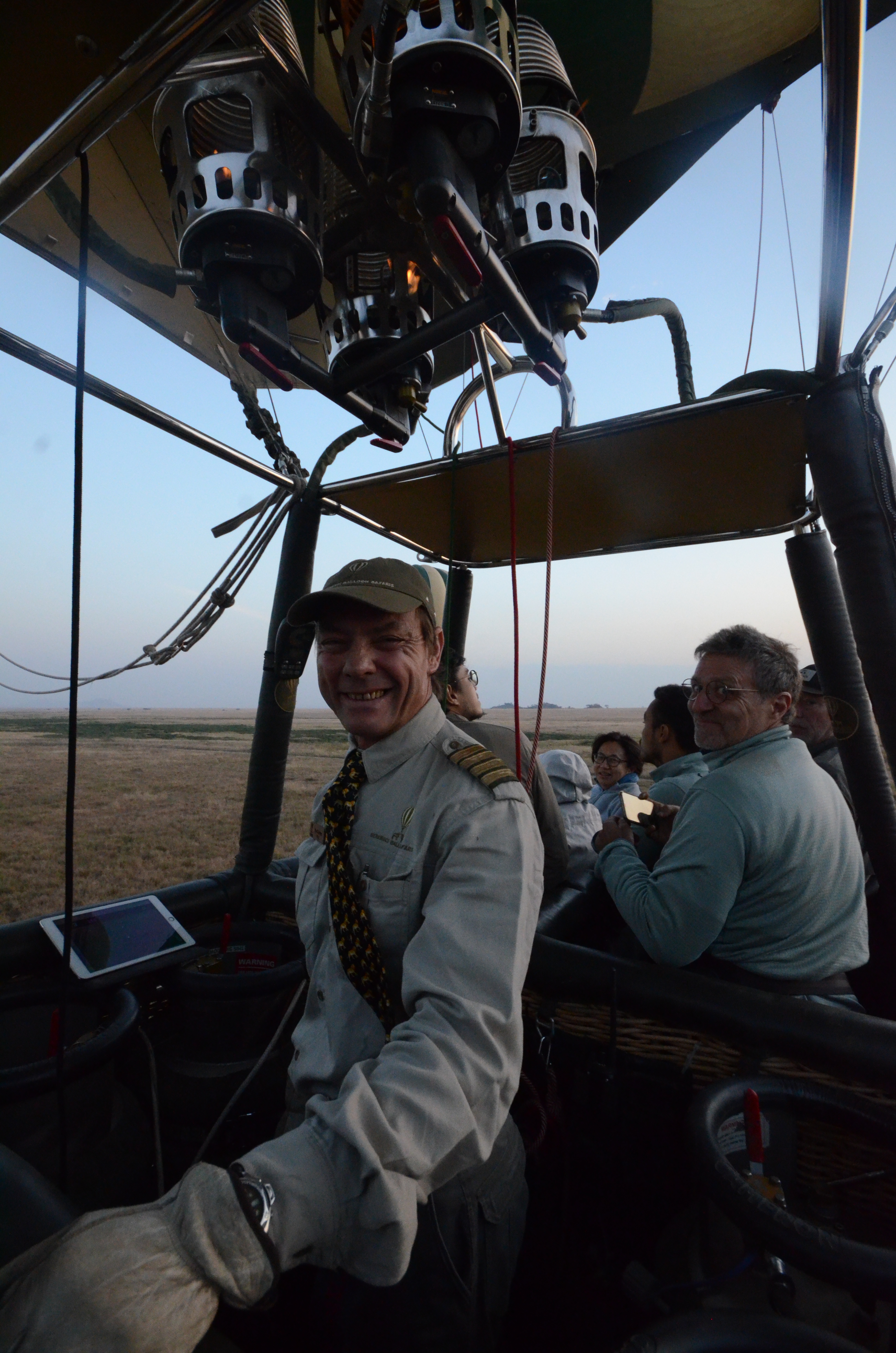
We were quickly gathered together and instructed into our balloon, loading in “Astronaut position”. The balloon basket, on its side, had a small bench that you would sit on while holding onto straps at the baskets edge which was up at head height. Of the 5 basket compartments (4 edge compartments and the larger center compartment for the pilot) we were loaded into the compartment that, when the basket is on its side, is the top. This required a little acrobatics and channeling my inner child. We strapped ourselves in with the hot air balloon equivalent of a seatbelt, and told that once we get off the ground wed be allowed to stand. That came MUCH quicker than expected and soon after the basket was righted by the lifting balloon we were able to stand and look out at our attendants waving us off and wishing us a good flight as we gained altitude.

We were soaring.

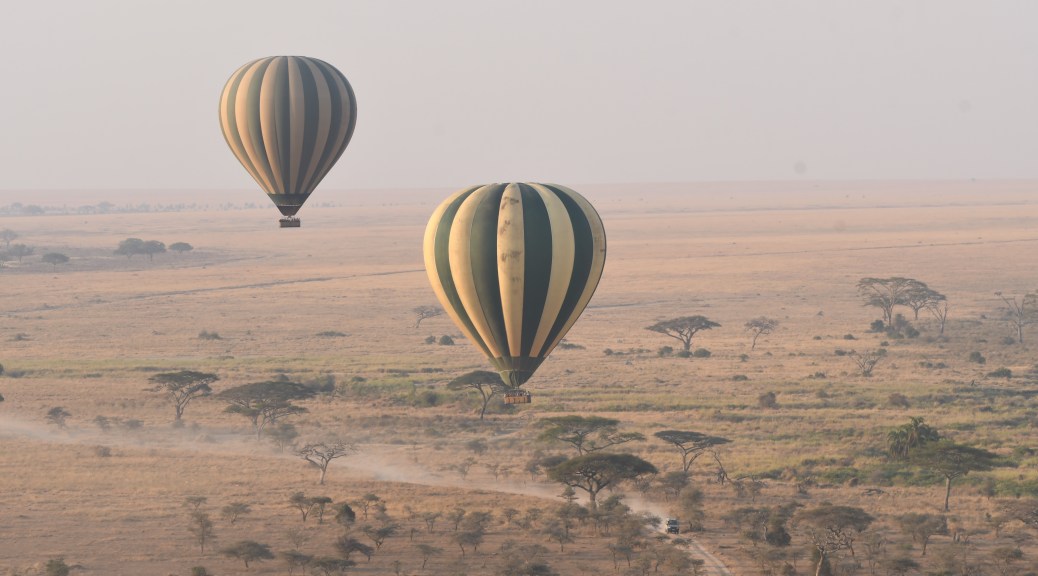
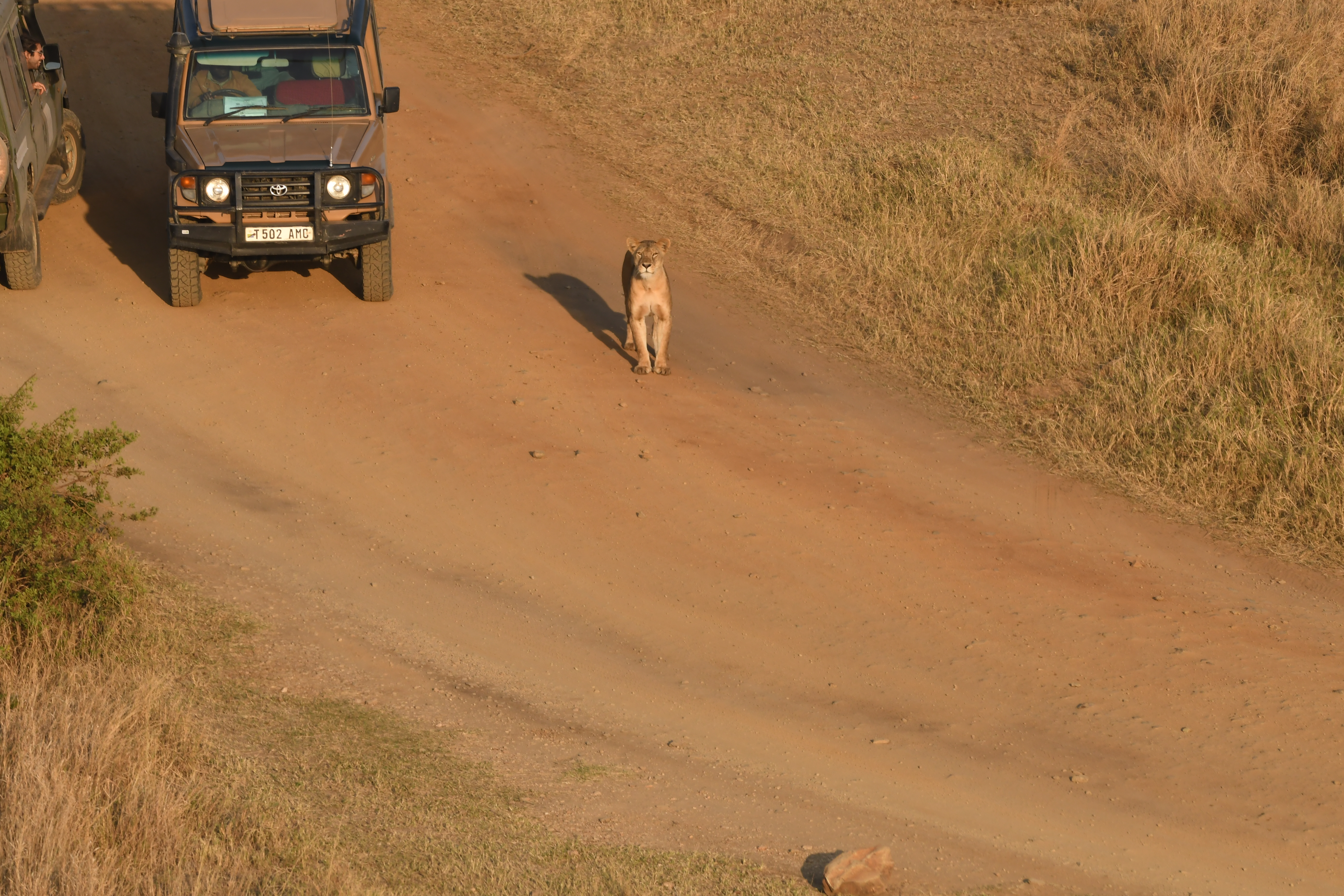
The chirps of the variety of birds around and below us, with the occasional roar of the ignition for the balloon gave an otherworldly view of the endless plain. Floating over treetops where baboon watched, and bewildered animals would stare at the strange bird floating overhead. The crocodile blowing bubbles to claim his territory from us, the giraffe lumbering away on long legs, the Lion standing amidst a group of tourists in pop-tops stopping to watch us as entertained as the humans around her.

A little over an hour of flight, and what may be one of the most amazing experiences of my life later, and it was time to land. We resumed astronaut position and had a fairly gentle landing where the balloon stayed upright and attendants (who had followed the balloons through the labyrinth of dirt roads to meet us) greeted us and helped us climb out of the basket.

There was an immediate celebration with champaign coming from the tradition of the first hot air balloon flights by French pilots, the very word Pilot coming from the French “Pillote” for someone who steers the ship. Of course Paul, our pilot, told us a few hot air balloon jokes then started pouring the champaign and mango mimosas.

After we finished we were loaded into pop-tops again and taken to a nearby tree, where a full breakfast layout was being prepared. We were treated to an amazing breakfast, complete with wifi to send off a few photos to make everyone back home jealous, and given our official ballooning certificate by Paul.

After Breakfast we were loaded up once more and taken to meet up with the rest of our group. While we were sailing over the Serengeti, they had been able to watch a lioness attempt a hunt. We swapped stories in the car while we made our way to the next animals of our safari. Seeing a crocodile and pond of hippos that we had seen from above a few hours earlier.

We came across a puddle of lion cubs resting under a tree, mum draping herself across the branches above our pop-tops. Valance, our driver, then got the call that there was a leopard spotted (pun-intended) not far away and we took off to go see it. We passed a heard of elephants, a tuxedo bird and a few more lion before we approach a large rock outcrop with large trees sprouting from the formation.

Atop the bulky tree, the sleek white and brown spotted frame of the leopard draped over a sturdy branch, lifting its head to look out on its gawking admirers. The line of pop-tops, cameras clicking and hushed whispers of awe not phasing the resting cat.

We made our way back to camp, where another tasty meal had been prepared, this time a squash soup with roasted vegetables paired with meat. The sun was setting, and looking for my headlamp before dinner I began to worry that I had lost my headlamp enroute to the hot air balloon that morning. My tentmate had hers, and invited me to stick with her to have light for walking back to the tent after dinner.

She and I grabbed our shower stuff and started to the bathrooms for our pre-bed showers and routines. as we approach the opening to the bathroom (as there wasnt a door, but an empty door frame leading into the facilities) I see a large formation to my left, about 7m/20ft to my left, the doorway being about a meter ahead of me. The little voice in my head began to tell me “There wasnt a rock over there earlier…”

I casually ask my tentmate to shine the light to our left.
“Are those… EYES!?” she gasped.
“Yup, lets get inside.” I could feel my tone kicking into what I call ‘Search and Rescue Mode’. I Kept my voice calm and authoritative and started thinking overtime for a plan.

If you have been following my stories of the Serengeti to now, you’ll know that before we even set off we were told to look out for eyes. Yellowish eyes are hyenas, Red-orange eyes are a Lion.

Two of the Australian girls were already in the facilities, and my tentmates panic started to catch. I ask to borrow the headlamp, and looking out the open doorway check to see what exactly where dealing with here. One… Two… Three… Four… Five pairs of blue eyes attached to large dark shadowed bodies. No one told us what blue eyes meant. I shine the light over the mounds once more, they range from 20 feet away (the one I saw on approach) to about 50 feet away. ah hah…
“OK, were dealing with some Cape Buffalo” I calmly inform over my shoulder, keeping my eyes on what is to some considered the deadliest animal of the Serengeti, “Not a problem! We’re just going to treat them like the Buffalo at Yellowstone. ” Mind you… I’m the only one in the room that has ever dealt with large land mammals while camping. This isn’t any kind of one-size-fits-all advice. When dealing with wild animals respecting space, and ‘reading-the-room’ become key. Thankfully this lot was happily eating and unphased by my tentmate and my approach. We got lucky. We all are going to stick together, and the Aussies wait for my tentmate and I to finish. I walk them through what I know about how to handle this situation.
“Thankfully they are all over on this side of the building, so we only need to get a couple feet to the well-lit side of the building and we can get the building between us and them. What’s important is we stick together, because then we look a lot bigger. And we don’t make any sudden movements.” I start pointing to each person “You walk in the front, using your light to light up and make sure were not coming on anything ahead of us. You walk with yours checking back to make sure they don’t come up behind us. And you will walk in the middle with me to illuminate where we are all walking. Ok? Lets go.” We orderly slide out the doorway and around the corner to the lit path towards the cooking facilities. With a calm in my voice, however forced to be casual, I narrated what we were doing, keeping them focused on our goal; getting to the other side of the building then over to the tents. Once in the tent area, we arrive our respective tents, and crawl inside for the night. I sigh a deep sigh of relief and think to myself “Well, this will make a great story later.”

Next Time: A flat in Ngorongoro for our travel companions, a tree full of lion cubs, a black rhino, and camping on the cool crater edge.

Where the Wild Things Roam: Lake Manyara

The morning started with the sense of adventure. All my camping gear that had been in my check on was redistributed on, in and around my backpack, a blue rain cover providing a small amount of protection from the dust we were told we would be encountering on the way.

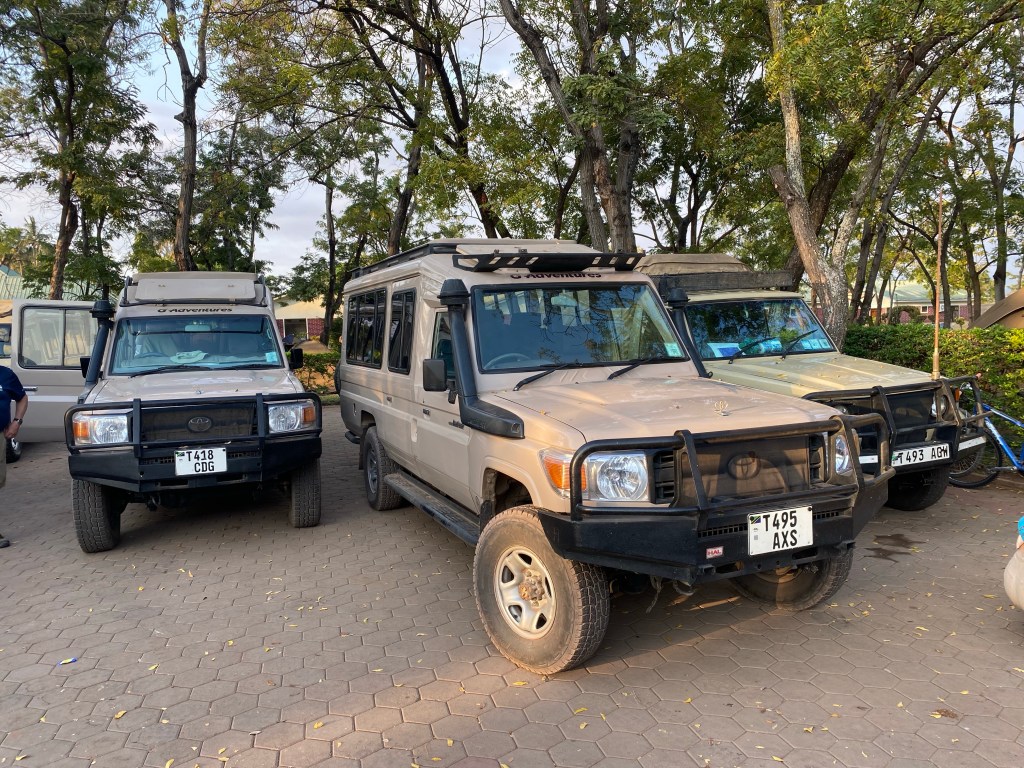
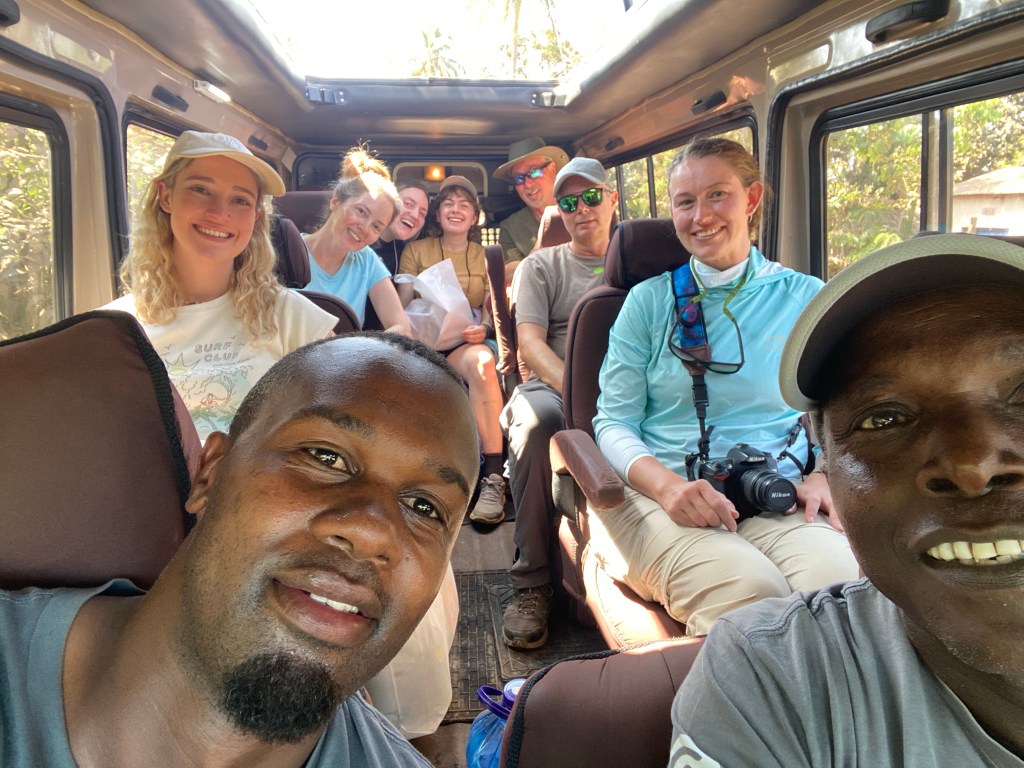
Checking out of the Outpost Lodge, our group convened in the small parking lot where two pop-top safari vehicles waited. Our drivers Valance and George greeted us and helped us load up. We split into two groups and made a quick supply run.

The local grocery had everything we could need for road-trip snacks and we loaded up with water. We were going to be camping and not able to access a lot of water for 5 days, and I figured that my own water amount was about 2 liters a day, and grabbed 3 – 2 liter jugs. My estimate was generous, and I didn’t get into the 3rd jug, but in 20/20 hindsight and a background in search and rescue, I appreciated having it to offer if anyone needed a water bottle refill towards the end of the trip.

Pro Tip: a week or so before traveling try to gauge how much water you drink normally, and then look at how much you drink the first couple days in East Africa. After being there a couple days you should get a good idea of how much water you will need to plan on.

Before setting off from the store, one of my travel companions tried the ATM to get some cash before leaving the city. The ATM ate her card. A few minutes of calling the 1-800 numbers in the states and the assistance of Hamdami in calling the bank of the ATM, and it was worked out that she would be able to pick up her card when we return to Arusha after the safari part of the trip.

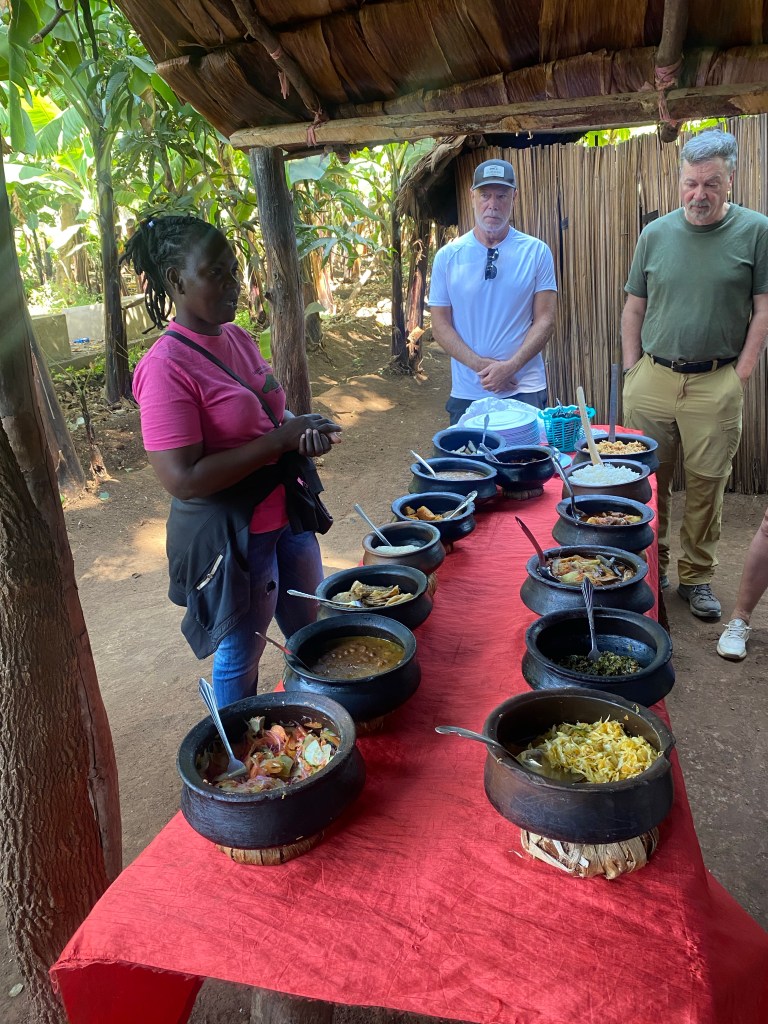
In the village of Mto Wa Mbu we visited a local art co-op, filled with a few artistic styles, and a banana plantation. Here we were treated to a lovely local meal with a diverse spread of flavours and options.

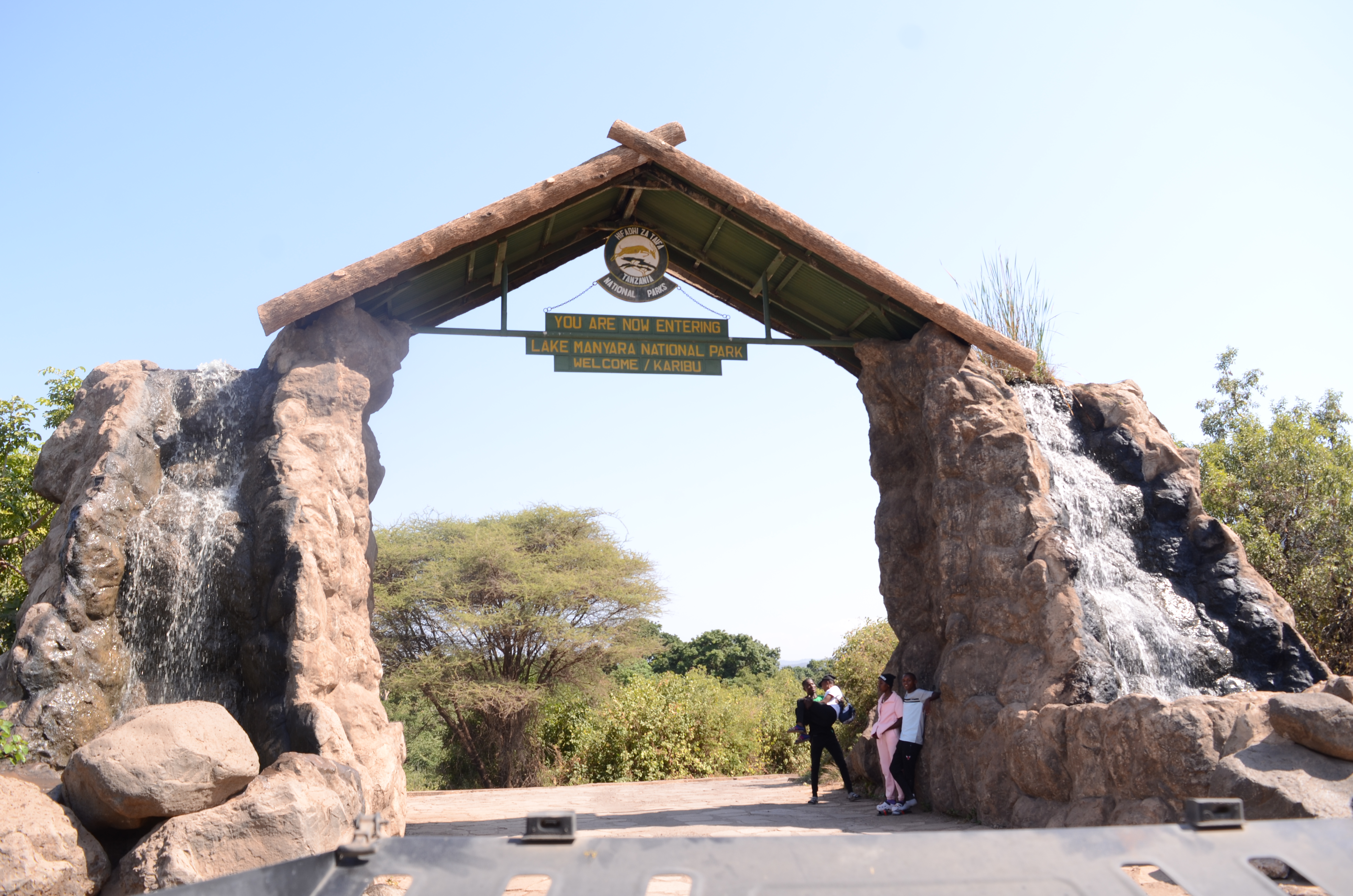
The first day of the trip we went right to Lake Manyara National Park. The entrance way was mesmerising, instantly cueing the Jurrasic Park Theme to come to mind. A magnificent archway supporting two waterfalls.

Just outside Mto Wa Mbu is Lake Manyara. Home of tree climbing lions. Though we didn’t see lions on this portion of safari, we did get an amazing experience with some of the elephants, who walked right up to, and around, our Safari vehicles.

The myriad of wildlife of the park was a fantastic kickoff to inland Tanzania. The baboons, water buffalo, and a particularly angry Zebra who had it out for a specific group of impala, gave the area a vibrant personality that, when looking back, was so unique. Neither Serengeti nor Ngorongoro Crater, yet somehow still with a sense of familiarity between the two.

While we would be traveling through the park, our supply car would beat us to the campsite and begin setup and cooking. By the time we roll in, dusty and shaken by the bouncy dirt roads, we had a little down time to freshen up and meet at the mess area for dinner.

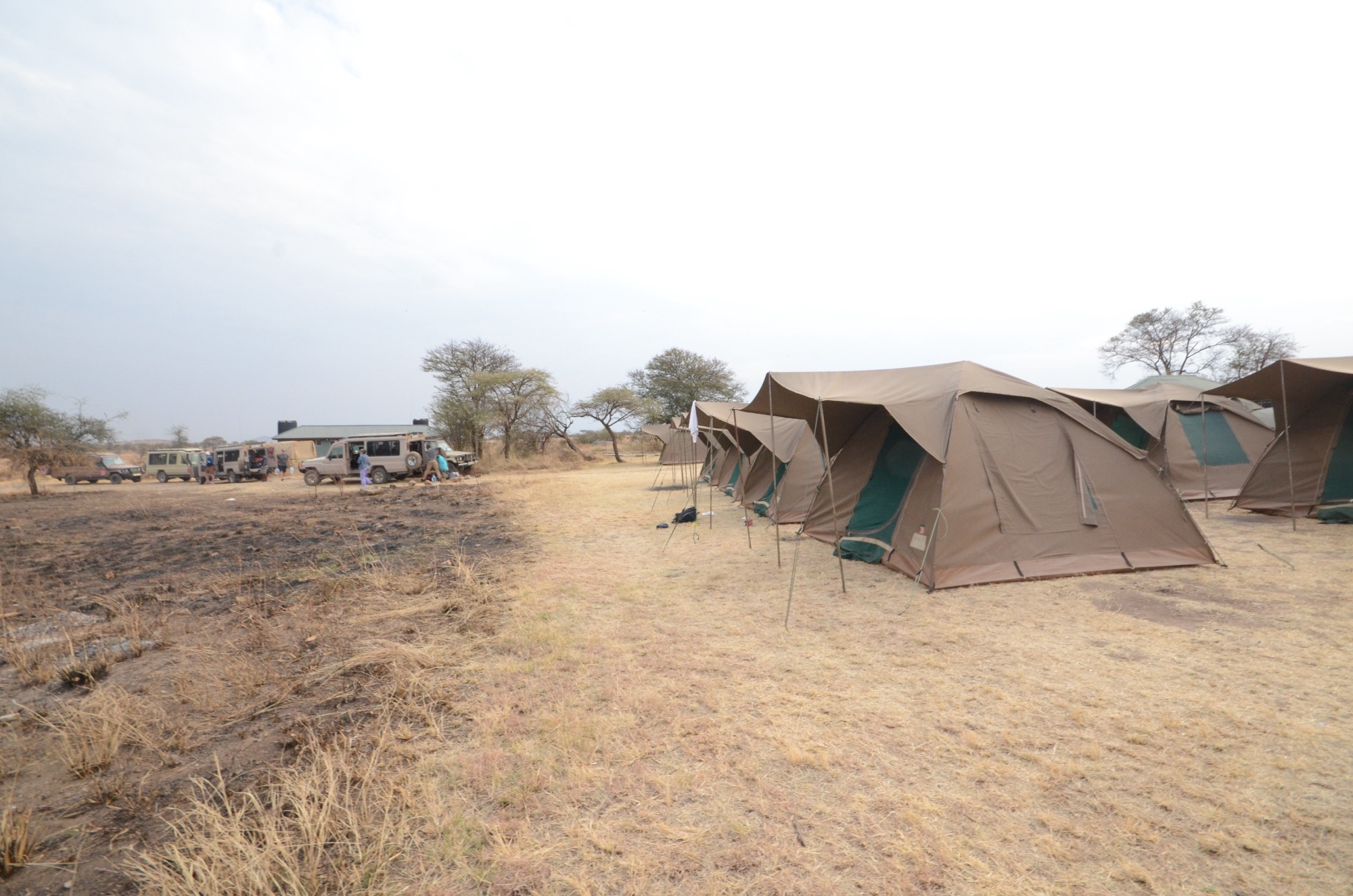
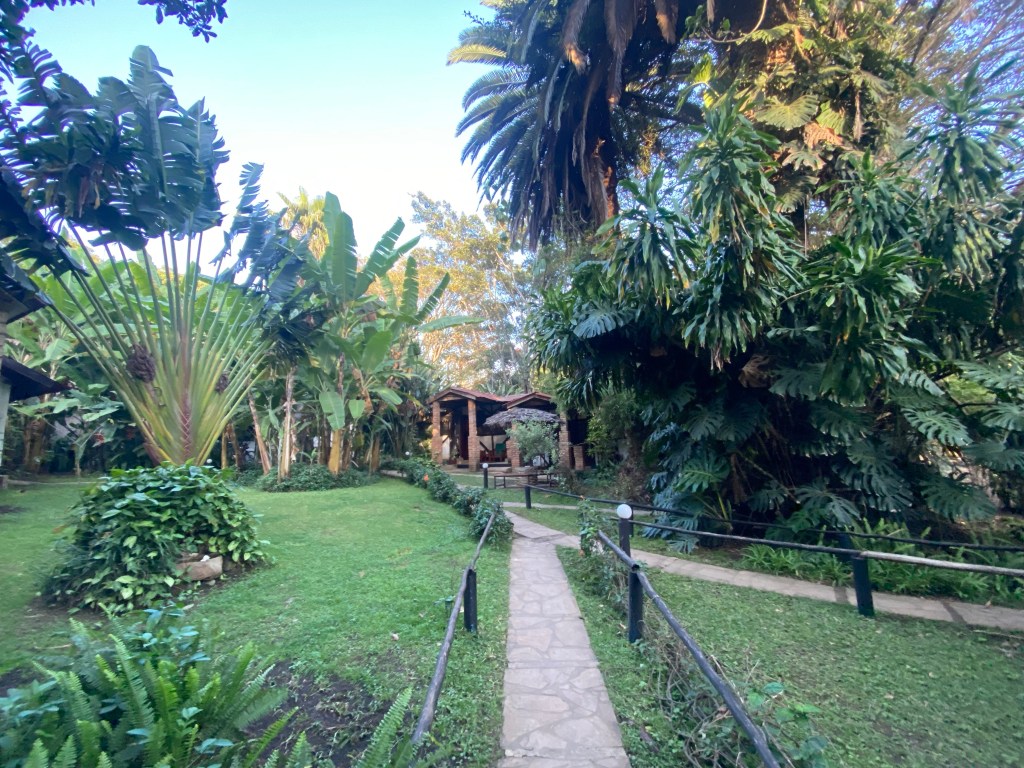
The Twiga Campsite is a lush, secure, campground within Mto Wa Mbu. Our tents, definitely larger than some of the other groups, were spacious and we could even stand up in them. Not quite ‘glamping’, but to my outdoor experience, not ‘roughing it’ either. I would say this was a very accommodating camping experience for anyone who hasn’t been camping before, or wants the camping trip style, but the tents already set up for them ‘vacation style’. A cold shower and frequent power outages that hit the small camps added to the sense of adventure.

The camp dinners were delicious 3 course meals. Shout out to Saranne, whose birthday it was and the camp crew came out singing a birthday song, equipped with cake, unphased by the power cutting part way through their melody. Power came back, celebrations continued, and it was a wonderful night at the campground.

Before bed I spent some time in the mess area charging my camera gear and batteries. My Nikon D7000 and D500 take the same kind of battery, so having just a couple extra made it easy to switch out. I highly recommend a multi port USB charger for the safari cars, and a usb charger for all electronics, including camera batteries.

The quiet of the camp in the evening and in the early morning was magical. Brushing my teeth I would stop, wide-eyed, realizing the far off sounds of lions roaring and hyenas chattering. This… the sounds, the feeling, of being surrounded by wild. This is what I came for.

Next time….

We journey deeper into the heart of Tanzania, passing through the Ngorongoro Crater conservation area and into Serengeti National Park.

If your interested in seeing some of the posts from one of my guides? Valence has an instagram! his adventures can be followed at @vah_ley_tz

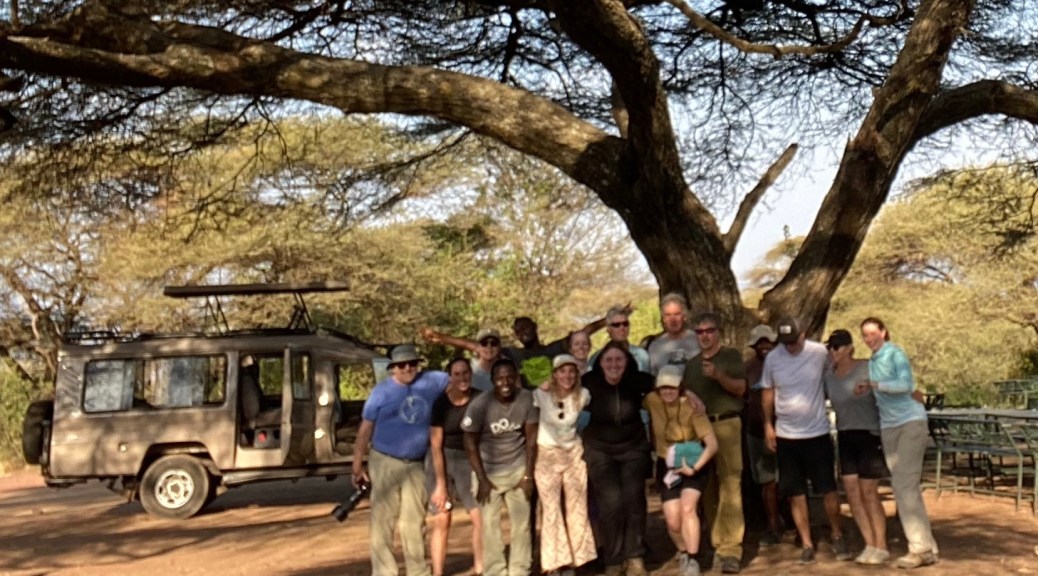
The cool kids!

Nairobi to Arusha: Border Crossing Adventure

Our team had made it down to Arusha on a public bus, all of our gear strapped under tarps on the roof at the Heron Hotel in Nairobi, picking up a few people at the local stop before making our way out of Nairobi and to the Tanzanian border.

At the boarder we debussed and followed the assembly line, Departures from Kenya, Vaccinations, Arrivals, and Visa. The Covid vaccination requirement had just been lifted a month before my arrival, but I still carried my vaccination card with the rest of my vaccination information. The Yellow Fever vaccination was the biggest one they were looking for.

Before I had left home I had stopped by my county’s Public Health travel advisor; a Nurse who specializes in what vaccines and health advisories you want caught up in for each region of the world. I HIGHLY recommend this, as I was able to get caught up on a couple other vaccines that I may have let slide… but going to a third world country would definitely want. I also got my malaria tablets and found that there are multiple versions of such a beast. Some people on our trip had daily ones, where as mine was once a week and you take it a couple weeks before, during, and a couple weeks after your trip. I became the envy of the campground as others were constantly reminding each other “Did you take your malaria tablet today?”

Once through the vaccination line, the subsequent lines became longer and longer. If there were ever the description ‘organized chaos’, this would be it. Some people missed a line so had to go back, a local woman with a child skipped lines and just waited at the front until someone let her cut. The visa can be paid for at the boarder with a credit card, even though they will definitely tell you they prefer cash.

A story from one of my travel companions was that a member of their previous group was paying cash and told more than what the visa was supposed to be, the official pocketed the difference and issued the visa. Unfortunately this isn’t all that uncommon. Additionally as an American, the fee was already twice that of other nationals, so I made sure that I had that set aside with my passport for when it was time to go through it was already budgeted. You are also able to apply online and take care of every thing digitally before getting there, I would just make sure you keep good documentation of it.

The assembly line of customs took some time, and I was extremely grateful to my GAdventures guide who helped navigate the flow and help make the border crossing easy-peasy.

A note to the photograph savvy: it is highly illegal in both Kenya and Tanzania to take photos of government buildings, officials or signs. Thankfully I knew this before going, but you will be reminded. We drove through a military area and we’re warned not to take pictures until the guide said so.

Once back out at the bus with our luggage that was unloaded and brought in for collecting, we hoisted them back up to the roof attendant who strapped them back down under the tarps. Waiting for the last of our crew and bus driver to finish customs we were surrounded by Masai women selling trinkets, which were met with a solid ‘No thank you’, but they would still try their tenacious marketing methods.

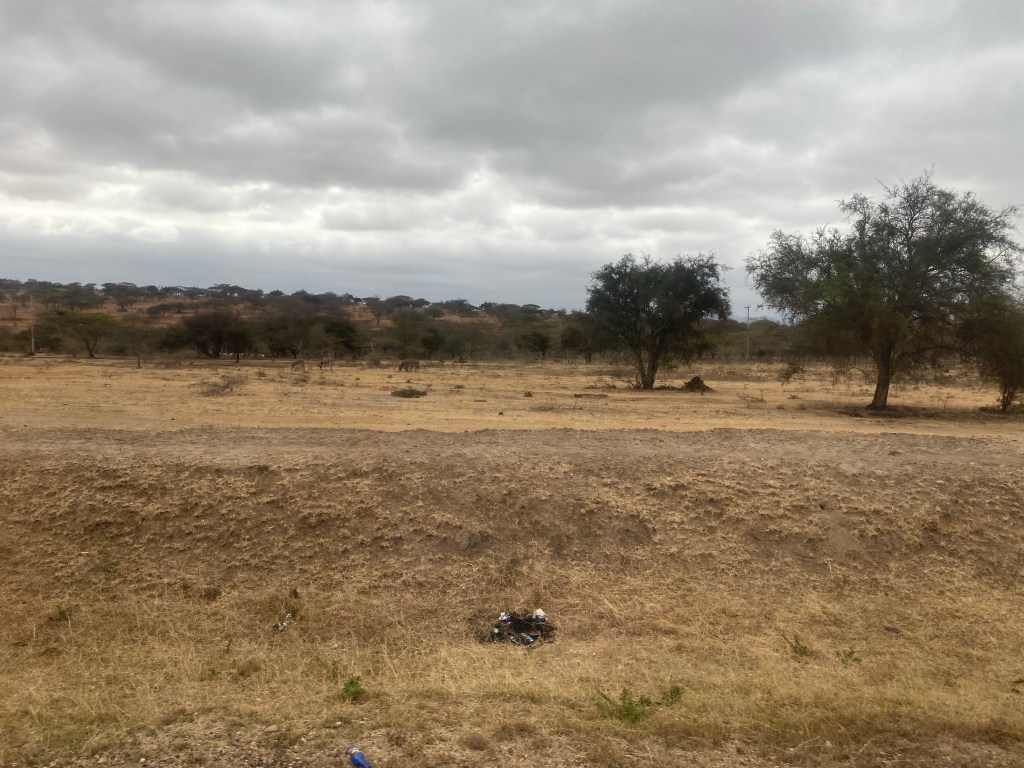
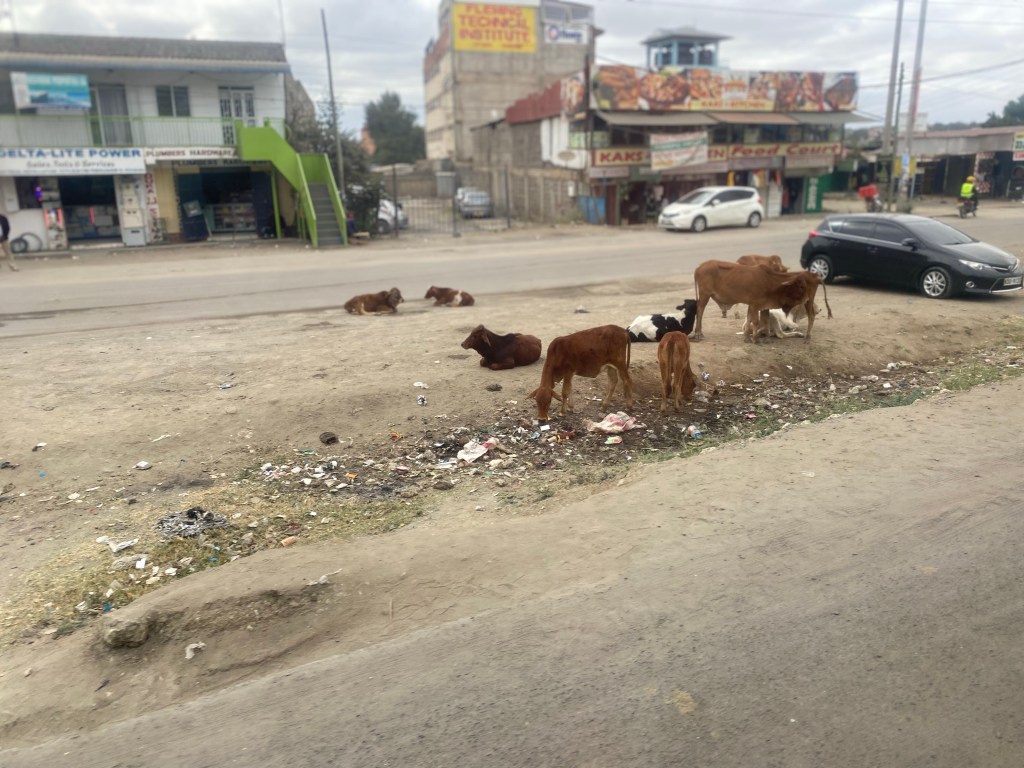
We reloaded onto the bus and continued our journey south. Some lulled, myself included, others gazed out the window at the passing villages and cattle farmer that were making use of the vast landscape. The occasional Baoboa tree amongst the Umbrella trees that speckled the landscape. At one point during the drive I saw a camel running down the side of the road. I didn’t get a chance to get a picture, but looked around the bus in an incredulous “did anybody else see that!?” only to see that there were only a few people left awake. I had asked Hamdam, our guide about it later, and he said that some of the people who moved down from North Africa would bring their camels with them.

We eventually rolled into our gated hotel, the Outpost Lodge in Arusha and had a chance to settle in a little before our evening meeting.

The lovely lofted area that had a living-room feel is where we gathered for the run down of what the safari portion of the trip was going to look like. We met up with another group of 6, brining our total to 14. They had just finished climbing Kilimanjaro the day before, and slugged up the stairs to the loft. Coming from a mountain region where I am on search and rescue, they were the magnificent 6. I usually need motivation for a hike and do more hiking to lakes and landmarks, summiting isn’t something I’ve done in years… and here were 3 Aussies in their 20’s and 3 Canadian retired business guys who went to summit the tallest peak on Africa at 19,000 feet. All except one summited because of falling ill at basecamp. Every. Single. One. earned some serious respect from me.

Hamdam gave a similar spiel to the one he gave in Nairobi… Look for eyes before leaving the tent…

Yellow eyes are probably a herbivore, no worries. (My mind still narrated, ‘hah! large animals… I’m good with not trying my luck if I see eyes.’)

Red eyes, please, for the love of god, don’t leave your tent. Those are Lion.

Next time…

We load up the Pop-Top, meet our drivers for the next few days, and start in the village of Wto Wa Mbu.

SE Asia in a Nutshell: Part 2

Ho Chi Minh City / Saigon

Saigon snapped me back into the mode of car dodging. The bustling city and flash night life was starting to draw on me, and the more active days with calm nights was a relief. Our first day of exploring took us into the Mekong Delta where we saw islands that were dedicated to different productions. One for coconut, one for honey, another for crafts. We were able to try fresh coconut candy, and were offered snake wine.
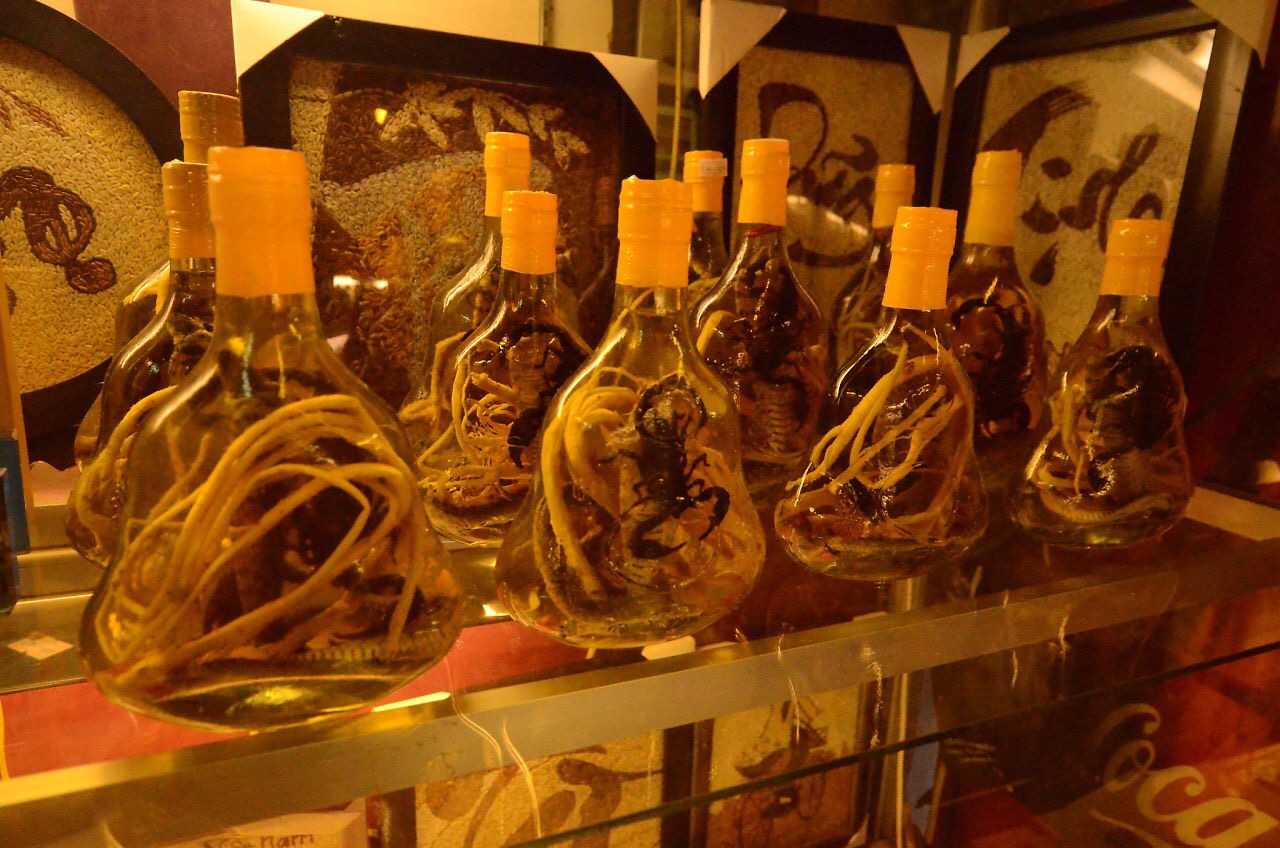
Snake wine, as some may know, is a harsh liquor that resembles cheap whisky. The triangular bottle houses bits of ginger root and a snake with a scorpion in its mouth. And it tastes exactly like what it sounds like. Sharp, spicy and strong.

Continuing on, we went to another island where we were paddled down a river in the small traditional wooden Can Tho small boats. We were making our way through the bamboo lined river when we noticed that all of the boats that were passing us in the opposite direction were waving at us and pointing to folded dong (the currency) in their hand. It took us a few boats to realise that they were signalling that we were supposed to tip our driver. If there is one thing I learned in Vietnam, nothing is free. Thankfully it’s all very cheap.

Cambodia – Phnom Penh


 We drove for about 8 hours the next day, which included the boarder crossing into Cambodia. The crossing was new for me, since we were coming in by coach and everyone on the bus had to give their passports to the bus driver who would give them to the customs official when we stopped. We had to take our valuable items off the bus and went into a large concrete ware-house looking building with the customs desks at the far end. We waited patiently as the customs official handed our passports back to our tour guide, who would call us forward and direct us to the bus that had moved forward to the buildings’ exit. I was nervous, as would anyone would be who has grown up knowing that it’s not the safest to part with your passport, especially in another country. Tom Tom, our guide, did a great job of reassuring us and definitely made the border crossing experience a quick and easy one. In Phnom Penh, we spent a day at the S21 prison and Killing fields.


Warning: the following may not be suitable for children to read. It was tough to visit. It was tough to write.


The bloody history of the Kumar Rouge regime is an unpublicised holocaust. The regime had gone around to the neighbouring areas and ‘recruited’ anyone who had a skill other than farming, knowing they would be a threat to the power of the Kumar Rouge. Trades people, and especially doctors and teachers, all brought to the prison under false pretence of jobs and a better life. Extending their reach, they decided to take whole families. After all a child could grow up to seek revenge. After being relocated to the S21 prison that was converted out of an old high school when the city of Phnom Penh had been deserted, the few remaining locals were resettled in neighbourhoods away from the school, and the screams. Millions of people were killed in that era. There were only eleven survivors; seven prisoners of the S21 prison, and four additional children who were smuggled and hiding in the kitchen. The others that were in the prison were executed quickly once the Kumar Rouge realised they were going to loose power, and took many of their prisoners the ten minute drive to the killing fields. The prison is renovated in some areas to show what it looked like before. Another area was converted to a museum area. And the last was left just as it was found, down to the occasional bloodstain. If the holocaust museum was built at Auschwitz, I imagine the tone would be close.

The killing fields, which are still not fully excavated, reveal bone and clothes after forty years. While walking along the raised boardwalk that winds through the fields, bones and bullets can be found within a foot on either side. In the middle of the field is a large memorial, where the skulls are displayed on shelves that create an encased pillar in the middle of the room, about 10X10 feet (3X3 meters).

I studied physical anthropology in my undergrad and we were able to work with bones of mummies that had been donated to the university. We learned how to determine gender, age, and certain causes of death that could be seen in bones. By the second panel of bones in the killing fields, I didn’t need to read the plaque. Adult, 25- 30, female, shot in the middle of her forehead. The next side of the pillar – children and under 20’s, some with their skulls not completely fused. After all, that only happens if you get the chance to grow up.

The history is dark, and for a few hours you feel any happiness sucked from you. Because of this repetition of history, I think if you are passing through Cambodia, you need to visit. Not because I want you to feel helpless to the carnage of the past, but because I really want people to remember, and not do insane atrocities again. At the least, the museum area has photos that the Kumar rouge had taken for records, which were the last many of the people had while they were alive. Personally, I like to learn about them so that they are not forgotten.
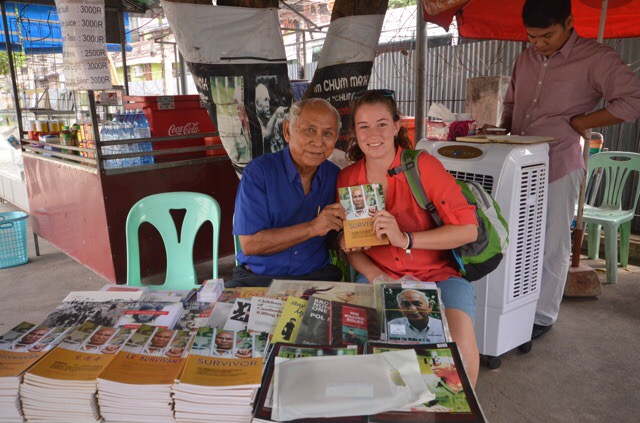
 Me with one of the 7 survivors of S21, Chum Mey, selling autographed copies of his book “survivor”.

Siem Reap


Right. Back to the fun, not-so-depressing stuff!


We drove in a small private bus from Phnom Penh to Siem Reap, stopping for a brief break at a roadside stand that specialized in a wide selection of deep fried creepy-crawlies. Of course, this is where my adventurous palette and I stepped up to the plate and ordered a tarantula and a few crickets. I have to say it – the tarantula tasted like chicken. It’s true. Like over fried, a little dry, crispy-breaded chicken. The crickets? Well, they just tasted like cricket. Not exciting in flavour other than the spices that it was cooked with. Just remember to take off the legs and wings, or you might find yourself with a cricket getting caught in your throat half-way down.
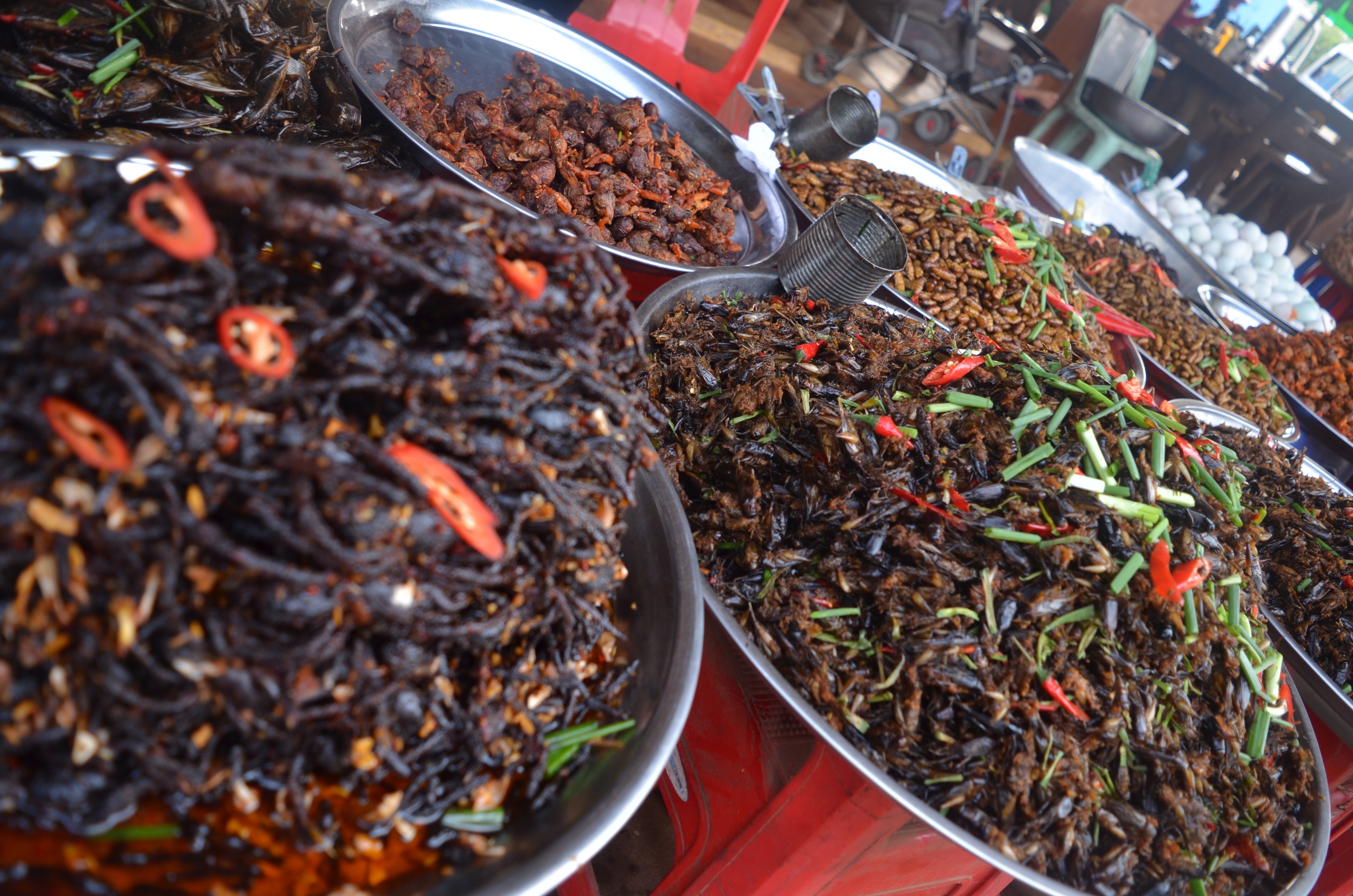

The next two days were spent at the Angkor Wat temple complex.

The first day we left the hotel at 4 am, clambering into the bus to go get our ticket and venture to the temple to watch the sunrise. As we made our way through the dark, I couldn’t even see the faint outline of any buildings. The new moon left the sky pitch black, with only a blanket of stars and plants to tell where – approximately – the sky ended and the horizon began. As the sun came up, the sky turned a faint pink, and the reflection created a magnificent silhouette of temple and palm trees against the dark plum of the cool morning sky.

Inside the temple walls we watched the sun rise, reflected in the small ponds that were originally built as water throughs for elephants. (Transport for the elite.)


The main temple was originally constructed with a mixture of Hindu and Buddhist architecture, and was meant as a communal worshiping place for both religions. There are monks that still practice here too.


The next temple we went to was the Bayon, also known as the face a temple. Each of the many rooftops has one face per a side, built to face the four directions. In the temple you can explore the maze of ruins, taking photos in the windows and has fewer visitors. The faces in the tops of the towers are kind of fun too.


We next visited the “Tomb Raider” temple, where the film was mainly shot, but between the heat and fighting a large crowd of people to get any photos, within an hour we were ready to move on.


The last temple we visited was “the hospital”, which was on an island that could only be reached by walking along a narrow wooden boardwalk above a bog. In Ancient times, they believed that the body ran off the four elements; fire, earth, wind, and water. The ‘hospital’ was five intricately carved stone pools, four on the outside and one large one in the middle. When you were sick, a medicine man would determine which of your elements was ‘missing’ and you would be ritually bathed in the coordinating pool to make you healthy again. If you were really close to death, you would be considered missing most of your elements and would be bathed in the large pool in the canter.


Our last night in Siem Reap, as part of our tour, we were taken to dinner at the New Hope restaurant. The New Hope Restaurant was created to give women working in sex work the opportunity to learn new skills and create a new life for themselves. The foundation grew and built a school that teaches English, a required skill for all the hospitality jobs. This was something that was organised as part of our GAdventures trip, and was amazing to be able to support.


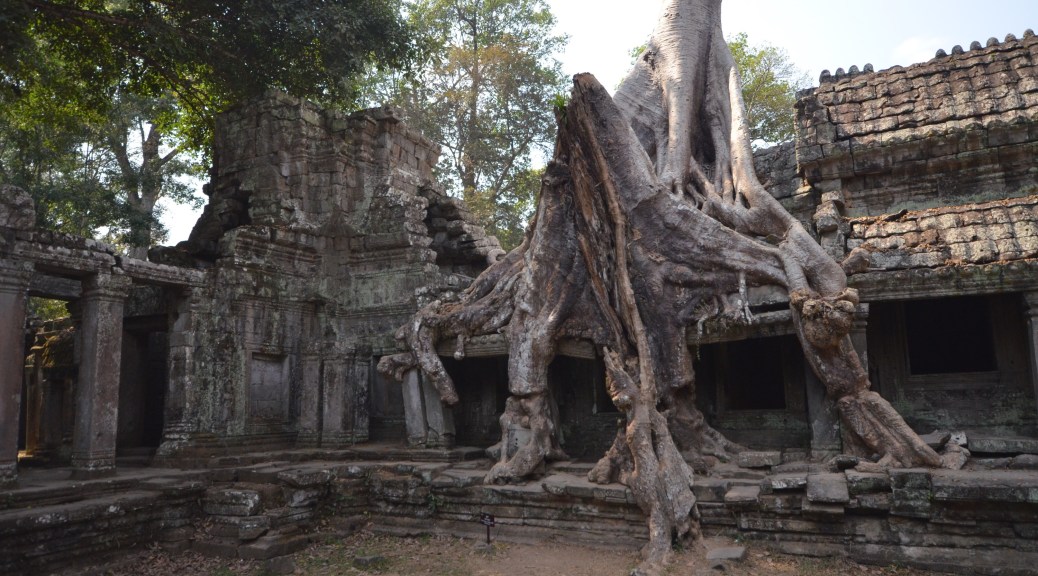
Fun fact: The elephant ponds at the main temple of the Angkor Wat complex were converted temporarily into a ‘fishing village’ in 2001 for the movie Tomb Raider. Restaurants in town still have their menus tagged with dishes that Angelina Jolie ordered when they were filming in Cambodia. The temple where they did most of the filming, the one with the trees growing into and around the buildings, is actually very small and very crowded. Be ready to have to fight your way through a crowd at any of the major temple sites.
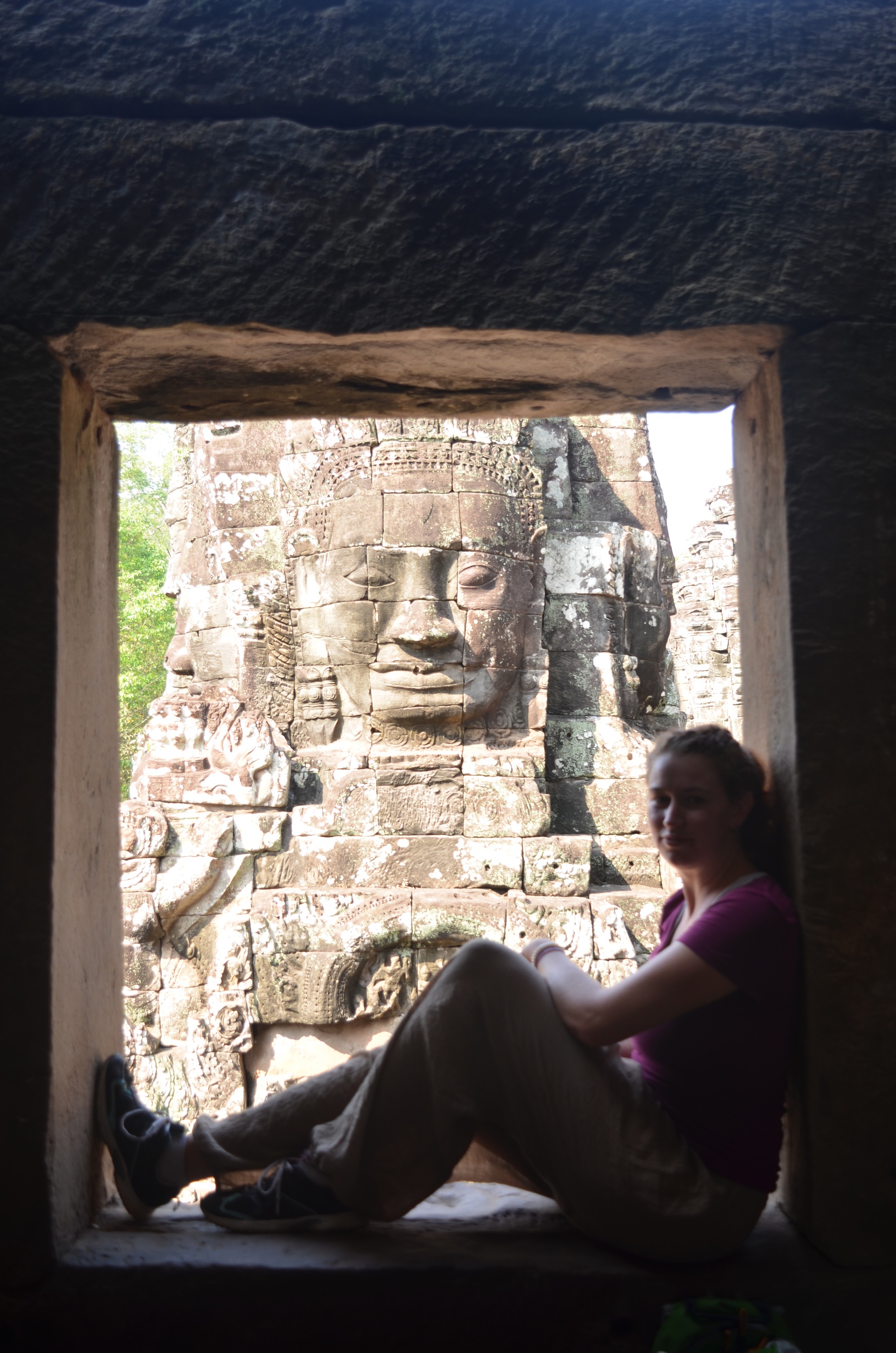
 

The smaller “face temple”, or the Bayon, is massively underrated, and really worth a visit.


Thiland – Bangkok

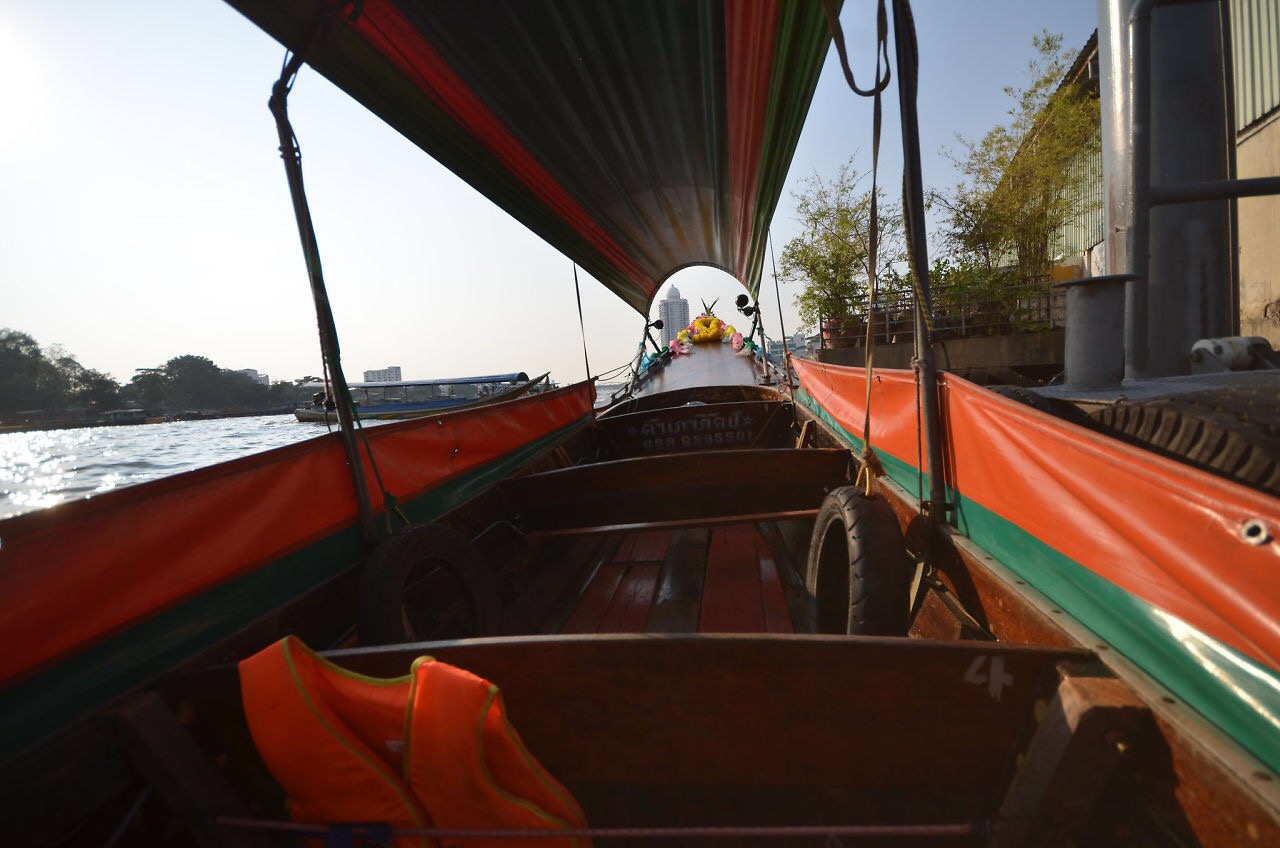
Bangkok provided us with our amazing race experience to the Wat Pho, the 600 foot Buddha statue.


We thought it closed to the public at 5 pm. We arrived at our hotel by bus at 4, so four of us girls ran down and grabbed a tuk tuk. The guy said that he couldn’t get there because of construction and we would need to take a boat. He brought us to the ferry terminal and the boat man (who obviously knew him) waves us over and tries charging us $40 for a boat ride that we knew should have been $3 each at most. We talk him down to $7 each and then instead of taking the water bus, he flags down a “water taxi” which is one of the long skinny traditional boats. Note: It doesn’t do well on waves and every time we hit a wake I thought the boat was going to break in two. When we pull up to the dock and there is a lengthy line for the water bus that we had originally planed on. We realized that the little boat may have been the best option, as now it is 4:45 and Wat Pho closes at 5 PM, we had to hurry. There was a dock hand that was helping the long skinny boats dock then you had to pay a “docking fee” which was just another way to rip off tourists. We paid it just wanting to get out of there and get to the Wat before it closed and took off in the general direction. We made it to the main crossroads by a government building, and start to question our sense of direction. Thankfully many of the buildings in the cities are guarded by armed guards and we figured “Lets ask the men with the machine guns for directions”. They smiled and told us that it was just around the block “down and to the left”, so we took off in that direction. We reached the next corner where once again we couldn’t find Wat pho, so we ask another set of armed guards. They also tell us “Down and to the left”, so we continue on to the opposite corner of the complex from where we started, but arrived at 4:55. Frantic, we tried finding an entrance where we can get a couple pictures before getting kicked out, and I saw the open sign that displayed “hours 8am to 6pm”. We had a whole hour before it closed.

Inside the complex, there were several structures covered in a tile mosaics that made me think of something out of Willy Wonka. The big temple that houses the reclining Buddha is MASSIVE. The outside is stark white, while inside is reds and gold leaf decoration. The statue itself was gold, and hard to take in at any one location in the temple.
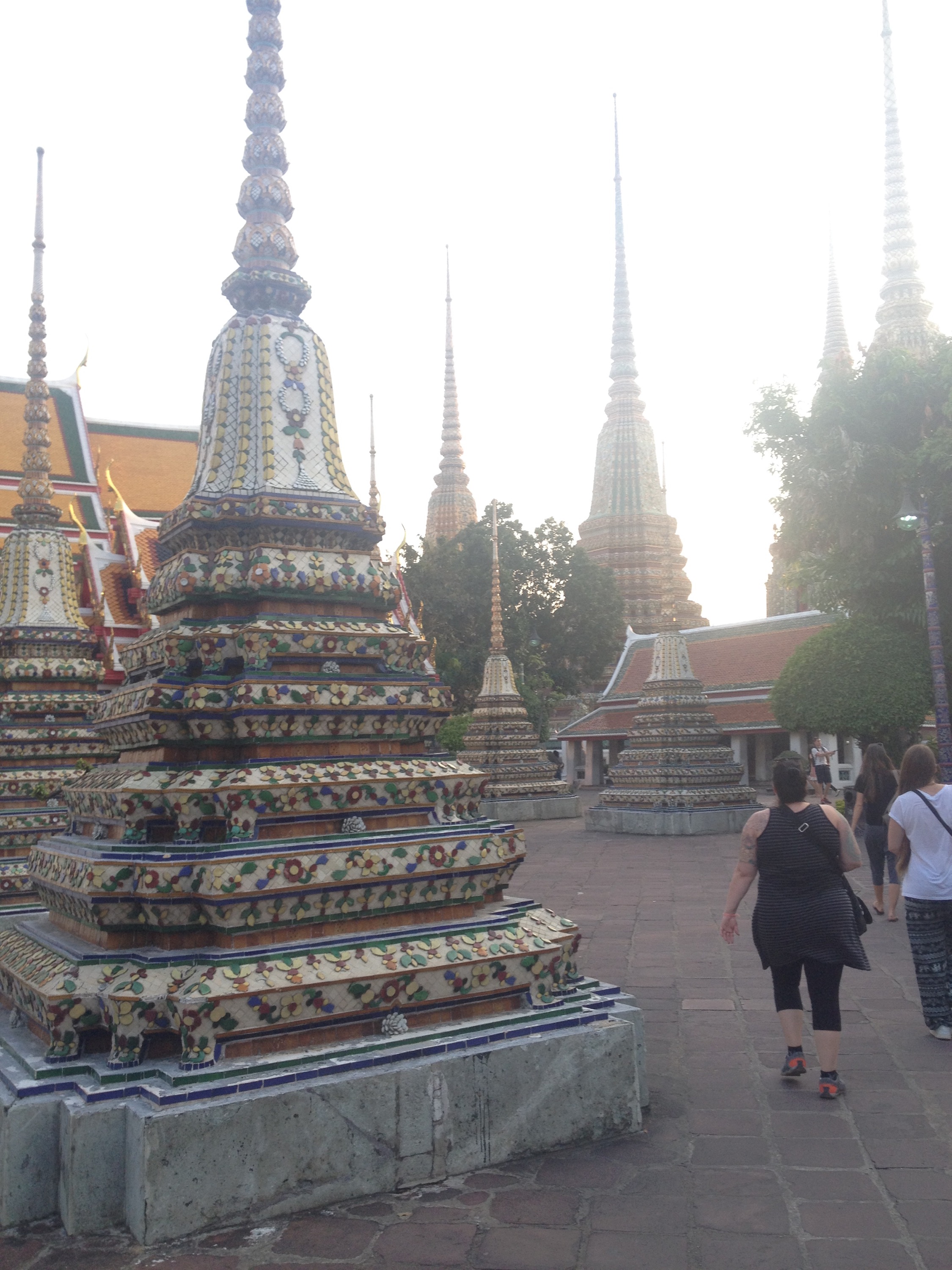

We wondered around the complex, and a group of the monks were just ending their prayers for the day and wondering around as well. When it was time to go we walked out the front door, and there was a tuk tuk that was able to bring us back to the door of our hotel… no construction to cause delays.


Chiang Mai


In Bangkok our groups parted ways. My ticket home was booked out of Chiang Mai, and I had no choice but to go look around. Still hesitant about traveling alone, I found that one of my fantastic new friends from the tour was also headed north to Chiang Mai, and we were going to meet a few days later.

While traveling through Cambodia, I discovered that Tom Tom, our guide, was from Chiang Mai and asked her for any advice about doing things and getting out on some adventures.  She told me about an Elephant riding outfit that she recommended because they take care of their elephants, saying there are cheaper programs, but she wont vouch for the treatment of the elephants. (Elephants are the SE Asian equivalent to work horses, there is still much debate about the ethics in riding them. Not to worry, there are a number of tour companies in Chiang Mai that offer elephant programs where you don’t ride the elephant, and still get to feed, bathe and pet it.) I was also advised that riding bareback is easiest on the elephants rather than riding with “saddles”, much easier for the elephants to handle and get used to, and can be trained through rewards. (FYI, They love bananas.) The program we went on took us hiking to a waterfall, where we were given samples of edible plants along the way. When the guide, had a large ant trying to bite his thumb, I pointed it out, and he shrugged casually and said “Its an ant.” And ate it. We stopped for a more substantial meal after the waterfall and had a local lunch of a yellow chicken curry on rice. Another part of the tour was to visit the Hilltribe people. They are part of the same overarching tribe as the long necks, though the practice of waring rings on their neck is dyeing out.

Originally there was the belief that members of the tribe born during a full moon would be more likely to be attacked by a tiger, and since tigers will attack the throat, tribes people originally wrapped their necks in rattan. As rattan is easy for teeth to get through, the tribes people switched to copper rings, which would offer more protection against tiger attacks. The practice is fading out because of the dwindling tiger populations, and the fading of superstition that your chances of being attacked coordinate with the lunar cycle you were born under.
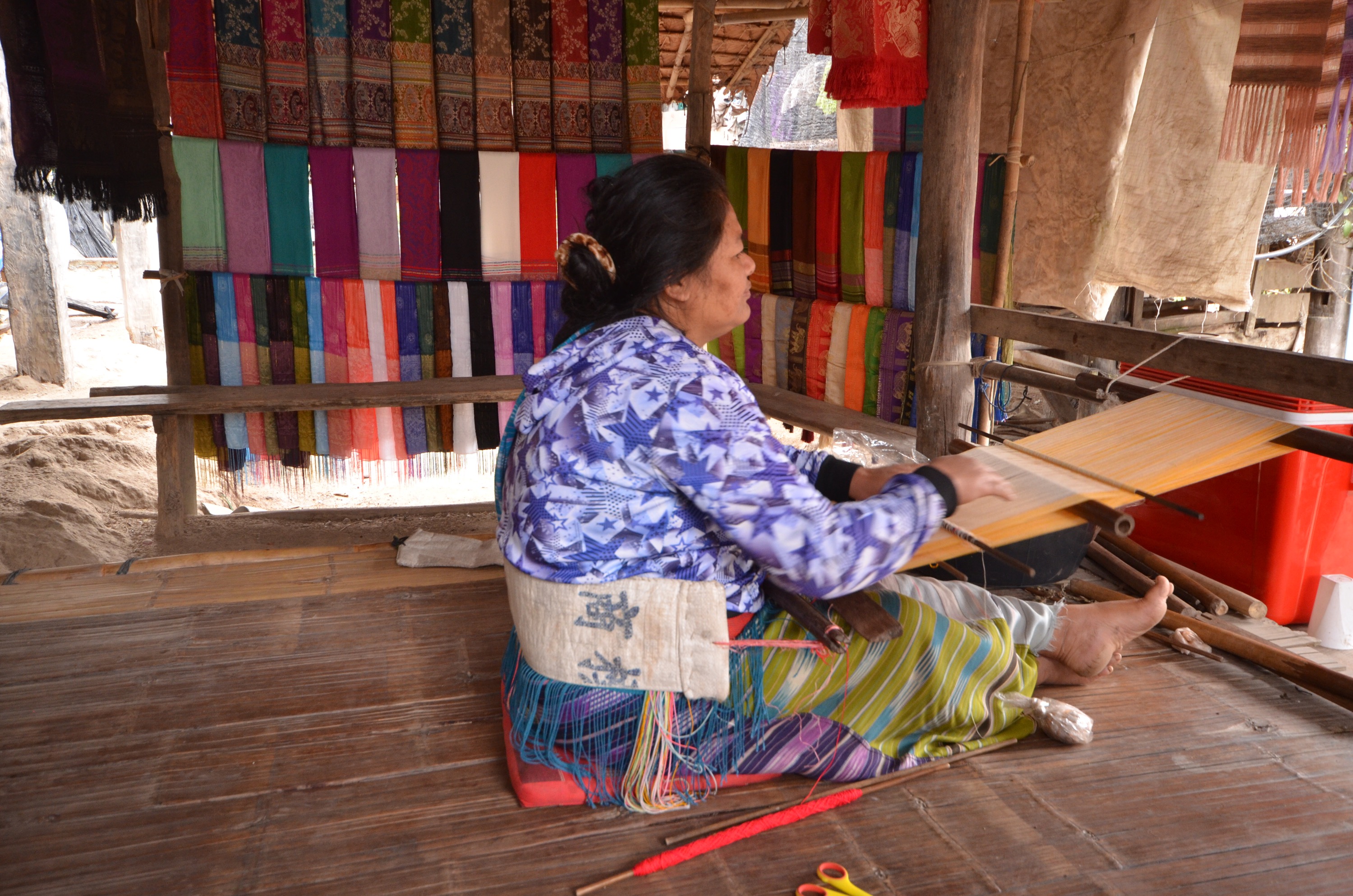
If you want to guarantee seeing the long neck tribes people, there are settlements that the Thai government established for tourism.

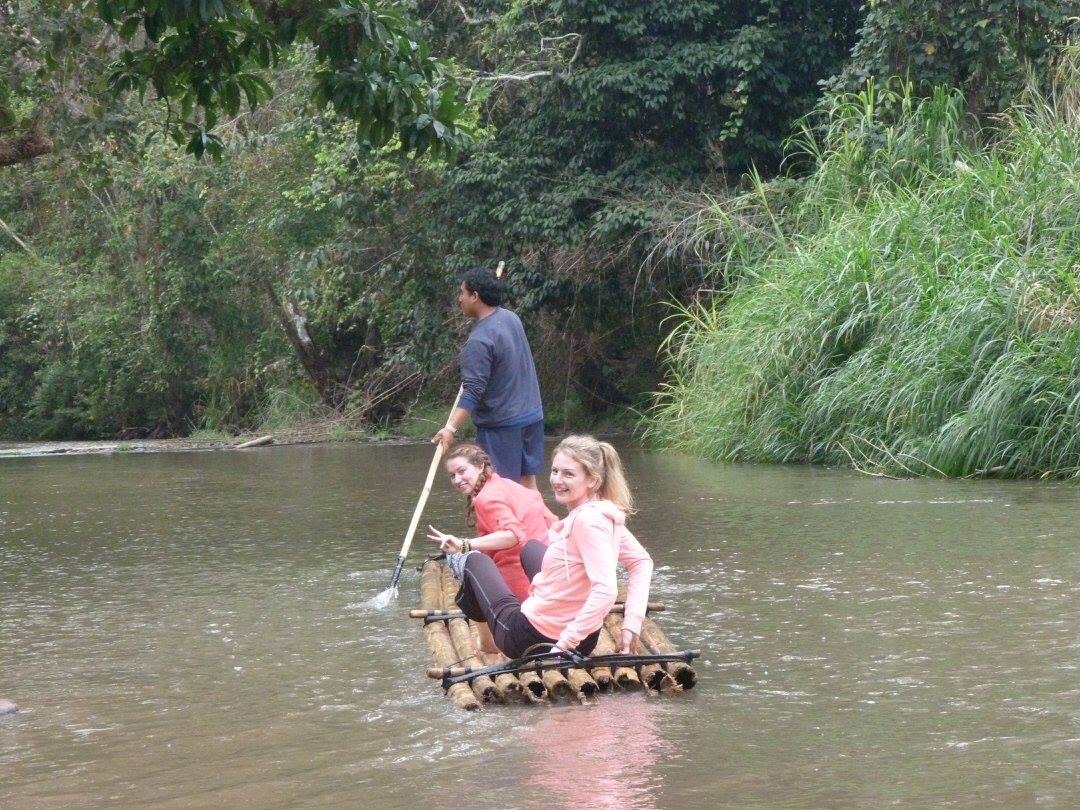
We continued into the forest to a farm where we rode elephants bareback for about an hour around the property. We walked down to the small creek where we were the elephants could swim, and then back to the farm.  Before leaving our elephants we spent some time just walking with them, feeding them bananas as treats. Finishing off the day, we did some bamboo rafting down a river that was cool, and quiet.

Another aspect of what I have found to be deemed “questionable tourism” is tiger photos. I have heard of the Tiger Temple, which is notorious for drugging and abusing its tigers. So I researched, did some asking around and homework, and found another outfit – Tiger Kingdom – which is more popular for its cub photos, because they have a lot of restrictions on who is allowed to take photos with the larger tigers. Given the size and nature, and the lack of information surrounding the larger tigers, there is speculation as to if the tigers are drugged.  The cubs however, were jumping and playing and each had 2 handlers on standby, with all of our moves guided by the handlers of what to do and when.  Since this was a bucket list item, I brought my camera and got to spend a bit of time playing with some tiger cubs. When my travel buddy and I left the enclosure, we just looked at each other and asked “did that really just happen?”

Singapore

When traveling to and to and from the field school/Chiang Mai I flew in and out of Singapore. With a 9-hour layover on the way to Vietnam, I had booked a hostel in the city, and decided I was going to use my time wisely sight-seeing.

I was sitting at my gate in the Brisbane airport when I hear a familiar voice call my name. It was one of my classmates that, I admit, I didn’t hang out with very much outside of class. She and I discover that we were on the same flights, and I invited her to join me at my hostel if she was up for the adventure. She agreed and we navigated out of customs, (thankfully for both US and Australian passports, you do not need to apply for a tourist visa,) grabbed some fast food, and caught the bus that was hostel bound.

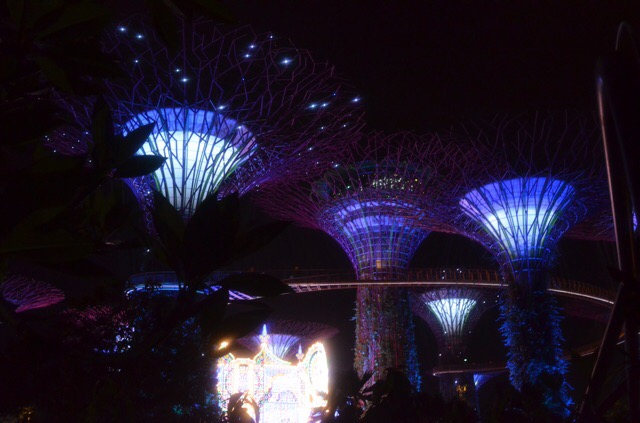
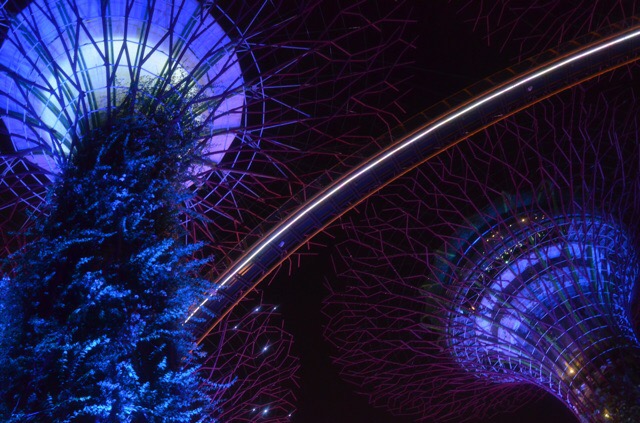
We checked in, dropped our stuff, and hailed a taxi to the Gardens by the Bay. The gardens have large greenhouse pavilions and a walkway through the manmade industrial trees, but they both close at 8 pm. We ventured along the walkways, finding an outdoor aquarium, and vantage points of the clusters of large plant-like structures. Lit in a neon blue, the structures resembled giant trees that mushroomed at the top, greenery growing up the sides, and white spots of light doted the tops like stars. A few hours of wondering around the gardens and it was time to attempt a few hours sleep before our morning flight to Vietnam.
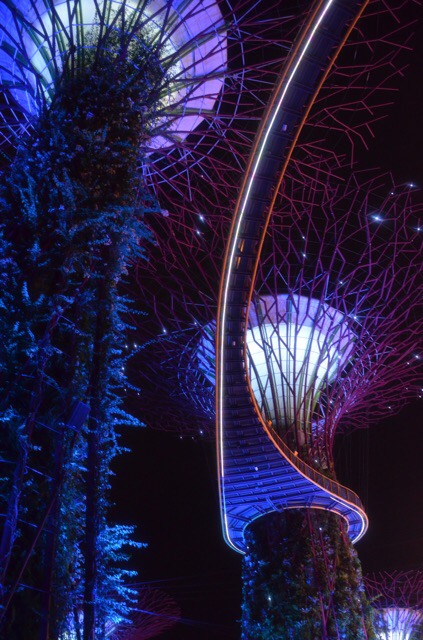
 
On the way back from Thailand, again I had a lengthy layover. This time seven hours. Singapore airport has won multiple awards as the “Best airport in the world”. I took the time to wonder around and find what the hype was about.

The airport has a hotel, public pool, two movie theatres, a game centre, free Internet, free massage chairs, and so much more. Gym? Yup. Butterfly garden with a waterfall? You bet. I find myself wondering if I can book an international flight back just to visit the airport.