
Studying in Australia gives a few unique opportunities. For me, it included the chance to do field school through Vietnam, where we were privileged to work with some amazing people learning how the museum ‘does-what-it-does’.
However, outside of class I wasn’t expecting to see or do much, as my mental preparation had my mind thinking “business trip” rather than “vacation”. Those who know how I travel know that every moment I’m not trying to be a good student is spent exploring. (After all, I use academia as my excuse to go far away for long periods of time.) As South East Asia is in the news frequently for tourists getting in accidents, trafficking, or other not-so-pleasurable happenings, I didn’t think I would go there on my own, no matter how much solo experience I have. Two of my classmates who were also going to Vietnam agreed and the three of us decided to book a tour and continue through Cambodia and Thailand after our studies.
Vietnam – Hanoi
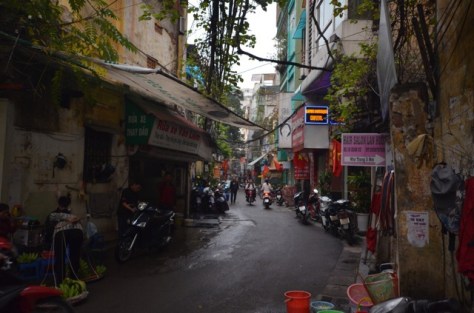
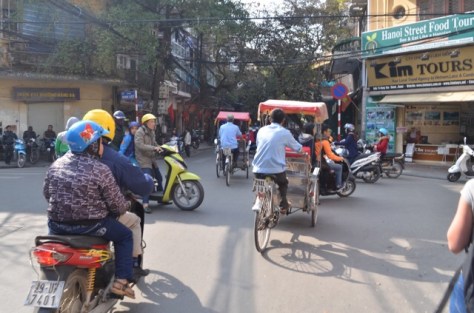
We started our two-week field school in Hanoi. The old quarter burst with life, vendors, pedestrians, and mopeds. Oh-so-many mopeds. The air was thick from humidity and exhaust in the narrow streets. The buildings, with their un-kept paint and traditional wood trimmings, towered multiple stories on either side. The ground floor housed open-front shops and restaurants with smiling and eager staff trying to wave you in for business.
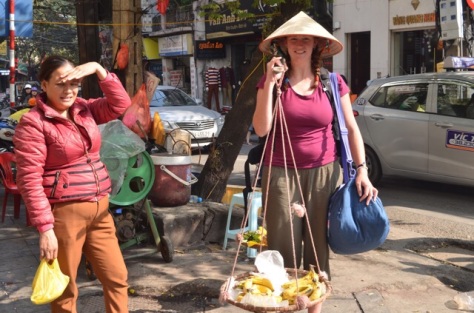
Walking along the streets, also be careful of taking pictures. We dubbed the women with the carrying baskets the “banana ladies” and developed the motto “beware of the banana ladies”. Within an hour of arriving in Hanoi I experienced my first of the photo cons. We were making our way to our hotel when a banana lady saw me taking photos and before I could get away, put her carrying stick on my shoulder and traditional hat on my head and kept pressing for me to take a picture. Me in my travellers hope that she just wanted to share her culture (after all that’s been my experience in most other third worlds) I passed my camera to my mate and had her snap the photo. As soon as the shutter snapped Banana Lady took back her gear and I thanked her and started to walk on now that she was, what I thought was obviously, done with me. That’s when she started yelling at me that I owed her 2 dollars. Ah hah! The next two weeks we had to deal with ladies following us down the street trying to put their carrying sticks on us as we would wiggle out from under them and continue on. Beware of the banana ladies.
Each street in Hanoi is delegated to different wares – tin, copper, glass, etc – and if there is something in particular you need, you can find shops competing on the same street.
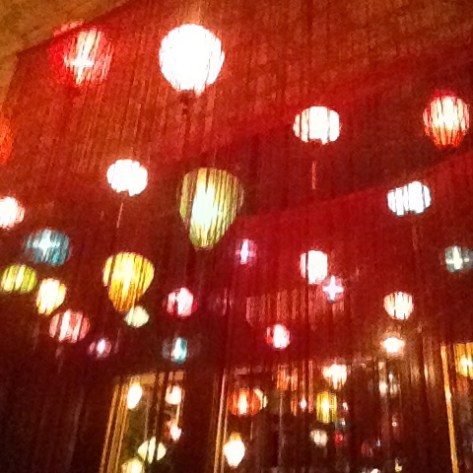
Food alley, while more expensive than the other shops that reside on another street, offers a multitude of options. In the heart of the city, the favourite of the field school was the Lantern Lounge, which could be identified easily at night by the plethora of lanterns that ornamented the face of the building. Once inside, you take of your shoes and sit traditional style at a table that is lit by many more paper lanterns draped across the ceiling. With free wifi and delicious vegetarian options in an English menu, we decided it was worth multiple visits. (When I travel I try to eat more vegetarian friendly because meat is usually harder to come by, and not always guaranteed fresh. So my rule of thumb is if you can’t read the local menu, don’t order anything unless you know what it is. I like to eat seafood in coastal towns, but since seafood can be temperamental I stay away from it if I have travelled more than two hours away from the shore.)
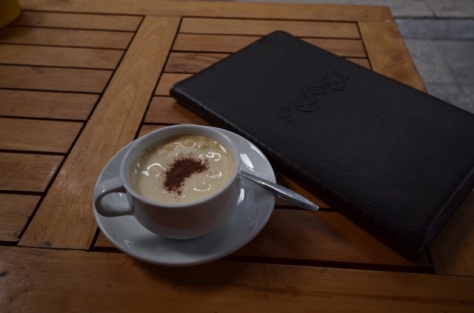
Another Hanoi specialty I highly recommend is the Egg coffee. It is the superhero of cappuccinos. A thickly whipped, sweet egg white topping layered on a cup coffee. That is a dissert in itself.
The Adventure to see Uncle Ho
While in Hanoi, morbid curiosity came over a few of my fellow classmates and I to visit the man we had learned so much about through our museum visits. After all, most of the museums in Vietnam display Ho Chi Minh as a larger than life demigod rather than the ruler of a country. His mausoleum is in Hanoi, and free to the public. Just remember the standard temple rule, dress modest, don’t lug giant bags in, and add that they don’t like you to take photos. That’s fine with me, I’m not too keen on photographing corpses, but the balmy heatwave in north Vietnam meant that one of my classmates and myself had worn shorts, which would have prevented us from getting past the many guards that were on the lookout for tourists that may be there to disrespect their highly regarded leader.
Once at the back of the 3 block line, we left our fellow classmates to find something to throw on over our shorts. The first shop we came across sold us a scarf to wear as a sarong and a pair of flow-y pants. We re-joined our classmates and continued through the line and past the video screens playing videos and testimony to “Uncle Ho”. When entering the mausoleum, you walk up stairs through small winding passages, designed to keep the climate-controlled room cool. Once in the room the whole experience felt surreal. The man in the open crypt in the middle of the room was stark white – no doubt due to multiple trips to be embalmed – and what interested me more than the marble looking man was the visitors that shuffled their way through with us. One older lady in front of us had streams of tears as she looked at him, and was offered tissues by who I assume was her grown daughter. Another man looked on in awe. I thought it was strange. It was strange to see how someone who has been long dead was displayed for the sake of his memory, and even stranger seeing the reactions to it. It was strange all around, but then, I’m not visiting embalmed leaders of countries every day.
Ha Long Bay
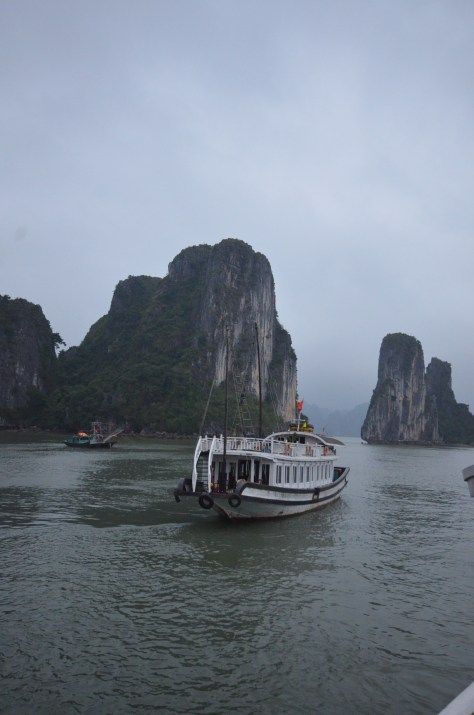
Though we stayed at a hotel for the duration of our field school, the trip I took to Ha Long Bay I booked a side trip through the FlipSIde Hostel. They were very friendly and if I were to do it again, I would stay there rather than our hotel. Options for Ha Long bay tours vary, but there is one for those who are just “passing through” and want a day trip to Ha Long Bay.
We left the hostel at 8 am, taking a small private bus about 4 hours to the bay, with a quick stop at a craft shop where all the craftwork is made by disabled locals. Once at the bay, we boarded a small motorised wooden cruise launch. A lunch spread of fresh seafood from the bay, with other additions, was provided for us to enjoy while leaving the harbour. In the bay, the sea cliffs rise straight out of the water, creating a maze of scenery.
Fun fact: James Bond “Tomorrow Never Dies” was filmed here.
Fun fact: Ha Long means ‘descending dragon in Vietnamese
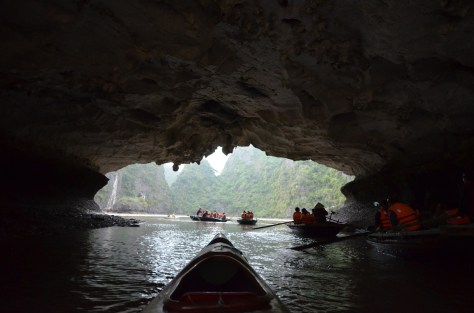
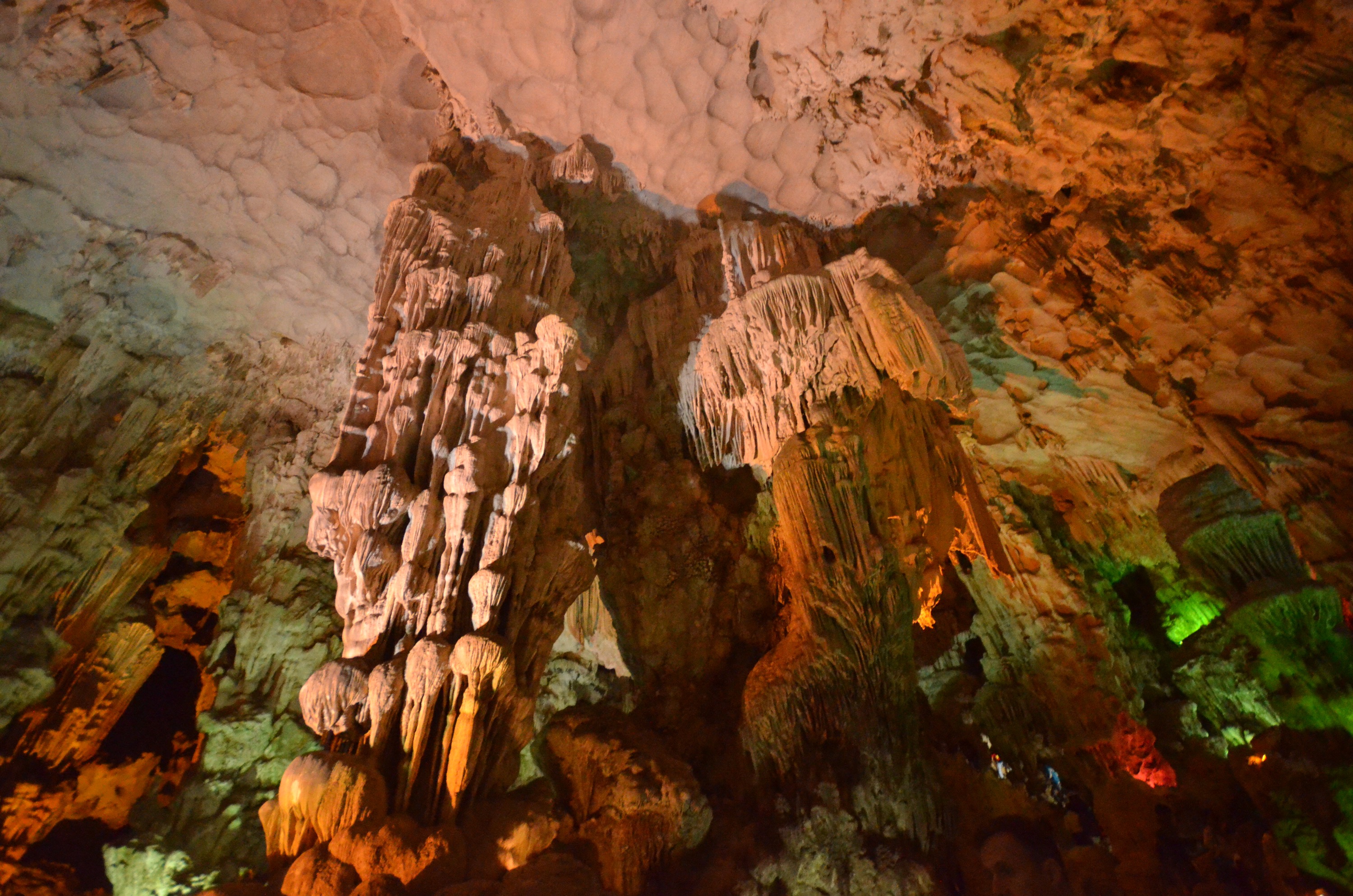
Our boat pulled into a little fishing village where we kayaked in a small bay area that connects to a couple saltwater pools via caves. After half an hour of paddling around, we made our way back to the dock in time to board the big boat again and go around the bay to a cave system that has been altered to hike through. The cave system is dressed with bright coloured lights that were put in to help show the contrast of the many layers of stalagmites and stalactites. One addition included a fountain in an existing pool. It was fun, beautiful, interesting, and no extraneous training was required to visit. But the complaint I heard most was it “looked like Ariels grotto at Disney world”, a bit cartoonish, and not authentic. In my opinion, it was an amazing day trip for less than $50. I would recommend it.
Da Nang
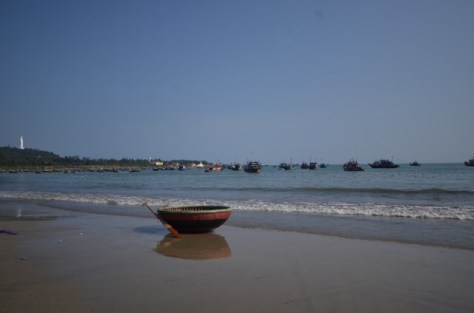
After Hanoi, we travelled to Da Nang. Da Nang has a slower pace than either Hanoi or Ho Chi Minh City /Saigon. With a beautiful river walk that exhibits local sculptures in a permanent art display, and the “dragon” bridge that shoots fire out of its mouth on the weekends, Da Nang is an amazing modern city to visit.
Hue
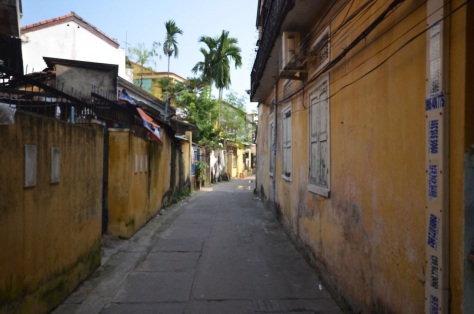
A day trip from Da Nang can land you in Hue (pronounced “way”), a wonderfully small tourist town. If you ever thought about getting something tailor made, this is the place to do it. The town is seaside, so the local specialty is oysters, and the seafood in the area is fresh from the boat.
After Da Nang, the field school was over. It was time to part ways with most of our classmates. My two companions and I went south to Saigon where we started our tour through the south of South East Asia with GAdventures.
 TravelGypsea