
Category Archives: A Little Knotty

A little Knotty: The Ethnography of a Sailor

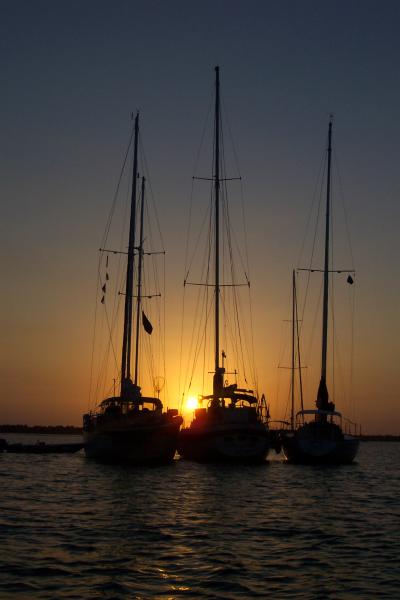
Rafting at sunset

There are multiple sub cultures, just like on land you can have mountain men, and hermits, spanning to high rise condos and mansions. This is the narrower band of culture that I was more deeply immersed in, with homeschooling and family life, and the broader scope of general boating social dynamics.

Sitting at anchor, using the sailing dinghy to get to and from shore, fishing for your dinner and burning candles for light.

Tied to the dock, with the utilities to provide modern comforts, and the car parked in the lot to go down to the shop for fresh veggies for dinner.

Transportation

One of the first questions I get about living on a boat is  “How did you get around without a car?” When living in a marine orientated city, there are many shops and conveyances very close to the water. In this sense the family car is the dinghy.

Shuttling to shore, and walking to your destination, provide an active and healthy lifestyle in addition to saving on petrol costs.  You are also more likely to buy things you need, and cut out junk food and inconsequential items that are not ‘worth’ the effort of hauling back to the boat. Quite frequently, people will have a bike, or small moped, that can be shuttled to shore in the dinghy to use.  In some instances, live-aboards who maintain port at a dock will choose to maintain the comfort of a vehicle for longer trips, and the boat being at dock is for longer term living.

Food and Diet

When living in the middle of the ocean your main sources of food would probably what fish you caught, and the edible seaweeds that you could harvest.  This style of living for long derations, and especially not planned, is rare. The common approach to long term voyages includes detailed planning of routes, studying weather patterns, and stocking up on rations before leaving port.

Before leaving for the Bahamas for 6months, I remember going to the store with my family. We had sat down and planned out what we would need to make each meal, then multiplied it by how many days we would eat that meal and multiplied that to how many meals we would need to ration the whole journey. Leaving out produce and other perishable items that we would buy in the islands, we still had 5 full carts of food to prepare for the journey. We had such a large number of items, they could not be rung up in the same transaction at the register.

Community Structure

The sailing community has three main niches; Marina, the hard (boatyard), and anchor/moored.

The Marina is considered the most social of the three niches. Here the equivalent of a neighborhood is slips along the pier. There is the ‘neighbor dynamic’; The neighbor that offers to help with some maintenance, ‘neighborhood watch’ becomes ‘marina watch’, and there are the conflict neighbors ( e.g. leaving lights on, music too loud, ext.). Marina offices usually provide a central hub to the social dynamic. If the office facilities are highly restricted and hard to access, there will be less interaction in these areas, where as a marina that provides larger free space to its guests will draw more people into the social setting. This would be the equivalent of the “city” of the boater world.
While on the hard, boaters are usually working on their boat, whether its basic maintenance or extreme repairs/renovations. The people that are in this working environment tend to have more of a ‘business’ scene, trying to get the job on their boat done.  The social dynamic of strangers in this environment is more of a friendly passing in the work place. Here it is assumed that people at the yard are doing some form of maintenance, or preparing for storm seasons.   The work yard would be most closely related to the suburb; people going about their business with some interaction, though there is ‘personal space’ associated with the area around the boat in addition to the boat itself. (Leaving a drill under your boat could be seen as the equivalent of leaving your lawn mower on your front lawn, it is assumed that the lawn mower, or in this case, drill, is associated with the property that it shares a space with.)

The ‘rural’ form of living would be at anchor or at mooring. When living with such large amounts of space between boats, interaction is limited. The most common forms of social interaction are particular social events (e.g. dock party on shore, meeting at a boat for cocktails), or spontaneous interactions (e.g. meeting at the dinghy dock en-route to the store).

Education

Families living on boats are often home schooled, allowing for mobility and convenience. With the diverse offering of education programs, there are  self guided work books, satellite ‘Skype-in’ class sessions, and other correspondence curriculum establish that can provide your standard education requirements. However, when living on a boat, there are the opportunities to study biology by dissecting a fish and taking the time to learn the organs, maritime history is common around coastal regions, and  (with homeschooling in general) individual interests can be developed by incorporating them with school work. (Like astronomy? write a paper on how Columbus used stars to navigate. Like electronics and chemistry? Perform an experiment about the conductive properties of salt water.)

The other education alternative presented was enrollment during the school year, leaving summers and holidays to travel. Restricting time allowances for travel usually is associated with leaving the boat at dock for longer periods of time and in many cases results in the family moving back onto land before much traveling takes place.

Waste/toilet

As you can imagine, I’m hitting all of what I think are the no-brainer parts of living on a boat, when a girl I’m talking to asks “this may be gross, but what did you do about going to the bathroom?” I had forgotten all about that naturally human action that is dealt with differently in this living environment.

On a boat the bathrooms are small, usually just large enough to accommodate a small shower and the head (toilet). The toilets are small, and manually flushed by a pump. Once ‘flushed’, the waste goes to a “holding tank” which is emptied by a pump at the dock. The other method of flushing is an Electisan which works like a septic tank, treating the waste for deposit into the ocean. Sink and shower drains have through halls into the water, or into the bildge (the open area under the floor of the boat which usually has a small amount of water) and is pumped out into the ocean.

Other trash should be stored for disposal on land, and organic matter can be disbursed out in the ocean to decompose.
A Little Knotty: The Correlation of Comfort and Cost.

This section will be a bit shorter since there are many variables that have to be considered, not limited to the length of the boat, where you want to live/keep the boat, and how much work needs to be done on it.

Living on a boat has its benefits. This includes the financial standpoint. The cheapest form of storage on a boat is to anchor it offshore.  In most areas, this is free, and if you have water tanks and a working alternator to keep the batteries charged, you should be able to stay like this for some time.

When buying a boat, remember, this is going to be your home, and there are many different sizes and layouts to boats. Here are a couple different types as examples – Irwin, Catalina, Beneteau, Formosa, and Hunter.  Each boat is different and will have a different price tag associated.  Websites such as sailboatdata.com offer design layouts of the interior of the ship. You can look on that site as well as sites like sailboattrader.com to research prices of boats for sale by the owner. Another option is to look into local boat brokers, and if you want to buy new, contact the company of the boat directly. On this last note however, I will offer the tip that the saying “they don’t build them like they used to” also applies to some boat manufacturers. Our Irwin is from the 1970’s and has a hall 2” thick, which provides insulation and would protect us if we were to hit anything in the water. Newer vessels have thin fiberglass halls. It is rare to hit something out in the ocean, but there are stories from friends of damage done to their boat by whales, and shipping containers that have fallen off cargo ships. As I said, this is very rare, but something to think about while searching.

Where boats start to cost money regularly is when they are at dock or on the hard.  In this instance, we go with the old stand-by ‘location, location, location’.

To begin with hunting down a good place to store your boat, remember this question “Do you allow live-aboards?” Some marinas (both with docks and dry storage) intend owners to leave their weekender, and not to have people living on the boat at the marina.  Asking this question before hand will eliminate headaches later.

The only times that you will want your boat landlocked and out of the water will be when you need to do work on it. This could take some shopping around if you would still like to live on it while you are out of the water. Dry-docks that allow live-aboards are dwindling. Don’t be surprised if it is necessary to travel to find one.  Depending on the work that needs to be done, you may be able to get the boat back in the water quickly. Long term storage would be something to consider during hurricane/cyclone season, when it is safer to strap the boat down.

Marinas offer the convenience of taking the boat out when you feel like it, and being able to come back to civilization. Most live aboard friendly marinas are located within a reasonable distance to town, and offer facilities such as washing/drying machines, lounges with TV, Internet, and electricity specifically for your boat.  Prices at the marinas vary based on amenities offered, and their location. A marina in Miami that caters to 100 ft mega yachts is going to charge more than a marina that normally takes day sailors and fishing boats. Research the area you would like to live in and call homeport. If talking to the marina and they say “we don’t take live-aboards here” ask “is there somewhere else you can recommend?” and ask other sailors; the sailing community is small.

A Little Knotty: Discover Sailing

032912140345

It’s the idea of pure freedom. The idea that, when you don’t like your neighbors, you can untie lines and move – taking your whole house with you. There is the powerboat lifestyle, zipping to the next destination quickly, and the sailboat lifestyle, where time and petrol don’t set the limitations to what you do.

While I don’t have much experience on powerboats, (or motor vessel if you prefer) I can put in my opinion about the sailboat. Sailing was the first form of long distance travel that wasn’t walking. Look at the Polynesians, settling from Hawaii to Easter Island to New Zealand, guided by stars and the waves. There’s still something majestic about being able to shut off all power, and be propelled by the wind in the unfurled sails. It’s the same force that has been around for 4 billion years, unchanged, and harnessable.

Don’t be swayed to the roar of an engine if you’re largest concern is not knowing how to sail. If you live by a coast, then there is a good chance that there is a sailing center or sailing club that may offer lessons. In the states that are land-locked, it is harder to take a drive to any facility that may offer some good advice, yet there is a good chance that if there is a decent lake, there will be a sailing community near by.  Check it out now, don’t wait till your retired. Mum and dad exposed us early to that lifestyle and it became one of the best things I have ever done.

In either instance, a good hands-on approach would be to charter a boat.

Boat chartering is becoming a popular form of vacationing. From a boat owner standpoint, it gives you a taste of the lifestyle without the overhead; the destinations are vast, from the Bahamas to Mexico to the Mediterranean, charters are available. Many times you are required to take a sailing lesson on the boat the first few days you are chartering. Read the fine print of the chartering company, find out what you can/cannot do with the charter. Understandably, there are limitations when chartering trough most brokers. (e.g. Must have taken a sailing class before chartering, cannot enter international waters without prior notice, ext.)

Lets say that the short term isn’t for you. That you have thought long about the thrill of the open ocean and want to get away from that ‘land lubber’ lifestyle, and want to jump into buying a boat.

If you want to go headlong into the boating lifestyle, I will give you a very useful tip – be willing to put in work. Buying a boat just after hurricane/cyclone season that has slight damage, and you are willing to put in the tender love and care, you can find a decent boat for a good price. Also look at marinas that offer dry storage. Boats that have been put on ‘the hard’ (the term for dry storage) and were forgotten for many years and abandoned over the years are sometimes put up for sale by the marina to compensate their losses.  These boats are the lost boys from peter pan, they just need some TLC and an extra coat of varnish (and maybe a new bilge pump, and some engine work, and a fresh coat of bottom paint, and some new sails…. You get the idea). They range from the slightly neglected to the highly abused, so it depends on how much work you are willing to put in/pay for.

Also research types of boats and ‘sample’ what they look like down in the cabin. Boats have different layouts like houses. Some have the strange passageways that you have to go outside to get to the next room, some have large living quarters, others have bunk-bed style births.

When we were looking for a boat, we had very basic requirements; mum wanted a bathtub, wide decks (for the sake of her many broken toes) and a larger Galley (dubbed the 2-butt galley, so we could fit more than one bum in the area at a time). Dad required a ketch rig and a large cockpit. After Hurricane Floyd, a friend of a friend had had some damage to their Irwin, which is what we had bought. The mast had snapped in the high winds. My father knew how to repair the damage, which made it the perfect boat for us.

Till next time – Bon Voyage!

A Little Knotty: An Introductory Guide to Living on a Boat

The waves lapping against the hull as the sailboat gently sways from side to side, the light wind causing the halyards to clang against the mast with an audible “trrriiiinnng, trrriiinnnng”, and the cool salt air cuts the heat of a warm summer night. As the quiet surrounds you, the faint crunching of sea life eating the growth under the boat echoes through the cabin.

It could be the opening to a great adventure/romance novel; in this case it’s how I grew up. 

Moving onto the boat was easy; I was 5 with two siblings and my parents, and the idea and opportunity were conveniently presented to our family. 

When we first moved onto my fathers’ 32’ weekend project boat, my parents feared we would not like living on the boat. This potential problem was put to ease during family ‘powwows’ in which they would check in with us after a day, a week, a month, then at one year we would look for a bigger boat. If we decided we didn’t want to live onboard, we would look on land. It took us a while to find the perfect family boat. After four years, and the promise of pets later, we were living nicely on a 42’ Irwin with 2 cats, a dog, and a fish named “Skippy” after the peanut butter jar we kept him in. 

The live-aboard lifestyle suited us. 

My brother, would don an eye-patch and his plastic sword, running the length of the dock to proclaim himself a pirate, my sister would race optimist sailing dinghy’s (tied for first in the junior Olympics one year), and I would sit on the bowsprit and write. We were homeschooled, which gave our family flexibility in traveling, but were granted many opportunities because of it. The first argument about homeschooling I hear is about being ‘anti-social’ and unable to relate to people. While I have met the occasional person who fits this stereotype, it is just that, a stereotype. We were always moving, I don’t believe that we ever stayed in one place for more than two years, and having this mobility allowed us to meet many people, not just a couple. We learned how to be friends with adults, and communicate on an adult level at a young age. We would have family nights, watching movies our 14” television, since we didn’t have cable. We would communicate by email, and my father had a pager for work until I was 9, when we got the first family cell phone. (Remember the time when cellphones didn’t have any graphics? They were just for calling, and if you were lucky, texting.) Our family became very close. The whole boat was the size of some living rooms and we had to learn to get along. Some of my land friends hardly saw their family together in the same day. 

As we would travel, we would meet other kids our age, also homeschooled and living on the boat, and we became our own community. We would switch off meeting at each others boat to do our homework; if we were the same grade we would help each other, and when a problem was too hard, we would ask one of the older siblings for help. We would meet people from Germany who would help us learn a little German, or from Quebec that would teach us a little French. When we arrived in the Bahamas, my mother distributed homework according to our age. My older sister interviewed a customs officer and had to write a research paper about the policies of the Bahamas, I wrote a shorter paper on the culture, and my younger brother had to do a project on the geography. We were always incorporating the location we were currently at into our studies. Taking field trips to the power plant, orange juice plant, or a tour of the St. Augustine fort would become homework assignments. Every year the Florida Homeschoolers Association would host a convention where curriculum vendors would sell textbooks and work books, lectures on teaching would be given to parents, and a graduation ceremony was given to the students who had completed their high school while homeschooling. This growing community was not just boaters, though the years that we attended this, we would be with our cruising buddies.  

Learning how to navigate using the sun, stars and a sextant, doing biology by dissecting a fish – while you were fileting it for dinner, and we didn’t have ‘home ec’ since we were expected to help with cooking meals and sewing, on top of washing the decks, filling the water tanks, and occasionally teak work and scrubbing the bottom of the boat. This was normal to us.

Most of the time we were at dock, plugged into power with small AC units fighting the Florida heat, and the convenience of being close to civilization. But when we were sailing from harbor to harbor, we had our dinghy to shuttle us to shore, solar panels and wind generators to power the fridge, water pump and lights, and if you wanted, you could go into shore for food and supplies. the rest was simple.  You sailed on when you didn’t like your neighbors. Kept in contact with your friends to meet up with them again.  And most importantly, enjoyed the little things, sunsets, 360 degrees of oceanfront property, being out of sight of land and seeing so many stars you cannot tell the constellations, and having those moments where all you hear is the lap of the ocean, and you know you’re home.  

How? You may ask. Where do I start? How much will it cost? Where will I live? Will we still have communication with the rest of the world? What do I look for in sailing communities that I cant find in my neighborhood?

I will warn you, there are no perfect answers. I will try to find solutions that will fit the most diverse of lifestyles, and guide where I can. I grew up on a sailboat, so that is where most of my information and advice will come from. That is why I wrote this intro; for you to see a little more of my background.  I studied anthropology, so now I look back in more of a cultural context point of view, and see it different then many other modern western-culture lifestyles.

This is just the first of a series of articles that I hope will inspire you to consider this culture, this way of life on the ocean.